

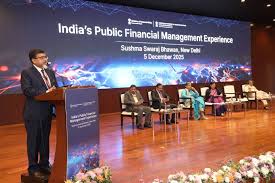

Speakers described India’s Public Financial Management System (PFMS) as a cornerstone of modern fiscal governance. Smt. Anuradha Thakur, Secretary, Department of Economic Affairs, underlined how PFMS provides real-time visibility of fund flows from the centre to implementing agencies and beneficiaries, enabling automated reconciliation and tighter fiduciary control. Integration with Direct Benefit Transfer (DBT) and digital payment rails, she said, has reduced leakages and ensured subsidies reach intended recipients.
The seminar emphasised how DPI building blocks identity, instant payments and secure data layers complement PFM reforms by strengthening auditability, procurement transparency and last-mile delivery. Delegates sought technical clarifications on reconciliation frameworks, payment verification and treasury workflows, signalling strong interest in India’s scalable solutions.
High-level participation and technical discussions
Controller General of Accounts Smt. TCA Kalyani opened the seminar with a focus on custodial integrity and “Koshpoorvah Sarvarambhah” the principle that fiscal action must begin with a disciplined treasury. Secretary (Economic Relations) Shri Sudhakar Dalela highlighted MEA’s Development Partnership Administration role in tailoring long-term capacity-building partnerships and DPI pilots with partner countries.
Technical presentations covered a broad PFM landscape: FRBM reforms, GST implementation, Government e-Marketplace (GeM), digital PFM architecture, e-invoicing and external audit practices. Presenters included senior officials from DEA, GeM, DBT Mission and the National e-Governance Division, who illustrated practical modules for fund flow management, procurement transparency and liquidity consolidation.
Toward a Global South PFM Forum
A central outcome of the seminar was consensus on exploring an institutional platform a Public Financial Management Forum/Alliance for the Global South. Delegates agreed such a forum could sustain knowledge exchange, support peer-to-peer pilots, and co-create PFM pathways tailored to low- and middle-income countries. Proposed areas of cooperation include treasury modernisation, DPI-enabled benefit delivery, procurement reforms and audit-strengthening.
India offered to support customised implementations and capacity-building through MoUs, technical missions and pilot deployments leveraging experience from PFMS, DBT and complementary DPI tools now shared with partner countries across Africa, Latin America and Asia.
Lessons stressed: rules, disclosure and federal coordination
Experts at the seminar underscored three policy lessons from India’s fiscal consolidation: rules-based fiscal policy builds credibility; regular disclosures reduce information gaps and support decision-making; and federal coordination mechanisms improve compliance between central and sub-national governments. Delegates discussed how these principles, supported by digital platforms, can help other nations strengthen fiscal discipline while expanding development spending.
Next steps and significance
The seminar concluded with a shared commitment to deepen digital PFM collaboration. Officials said follow-up technical workshops, bilateral pilots and a consultative process to operationalise the proposed PFM forum will be taken forward by CGA and MEA in coming months. Observers say a structured Global South PFM forum could accelerate reforms across many developing countries by making India’s digital-first tools and institutional lessons widely available.