
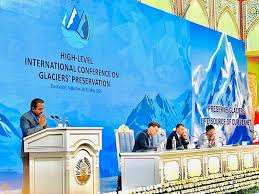
In a heartfelt and urgent message to the global community, India has once again emphasized the need for united action to protect glaciers—one of the planet’s most vulnerable and essential natural systems. Speaking at the High-Level International Conference on Glaciers’ Preservation held in Dushanbe, Tajikistan, from May 29 to 31, Union Minister of State for Environment, Forest and Climate Change, Shri Kirti Vardhan Singh, underscored the immediate and far-reaching consequences of glacial retreat and stressed the importance of international collaboration in facing this mounting crisis.


Representing India at the conference’s plenary session, Shri Singh warned that the melting of glaciers is not just a sign of global warming but a current reality that threatens the water security, biodiversity, and livelihoods of billions across the world. For India, this challenge hits close to home. As a country deeply tied to the Himalayan ecosystem, the retreat of glaciers in this region holds particular significance and urgency.
India, the Minister said, has already taken meaningful steps to address this issue. Under the National Mission for Sustaining the Himalayan Ecosystem, part of India’s broader National Action Plan on Climate Change, the country has initiated extensive monitoring and research efforts. The establishment of a dedicated Centre for Cryosphere and Climate Change Studies marks a pivotal step in advancing scientific understanding of glacier systems. Moreover, through organizations like ISRO, India is utilizing cutting-edge technologies such as remote sensing and GIS to track glacier health and changes over time.
Institutions like the National Centre for Polar and Ocean Research, the National Institute of Hydrology, and the Wadia Institute of Himalayan Geology are working in tandem to provide comprehensive data that inform policy and strengthen the resilience of India’s mountainous regions. These research-backed initiatives are helping to lay the groundwork for smarter disaster preparedness, especially in mitigating threats from Glacial Lake Outburst Floods.
Shri Singh also reiterated India’s belief in the principles of equity and shared responsibility in tackling climate change. He noted that despite contributing minimally to historical global emissions, countries in South Asia—including India—remain among the most vulnerable to its impacts. India’s approach to climate action, guided by the vision of Prime Minister Shri Narendra Modi, balances ambitious environmental goals with developmental needs. The country has already achieved a significant portion of its Paris Agreement targets: over 48% of its electricity is now generated from non-fossil sources, and there has been a 36% reduction in GDP-linked emission intensity since 2005. Additionally, India has successfully created a carbon sink of over 2.29 billion tonnes of CO₂ equivalent through expanded forest and tree cover.
Looking ahead, the Minister welcomed the global recognition of glacier preservation through the declaration of 2025 as the International Year of Glaciers’ Preservation and the upcoming Decade of Action for Cryospheric Sciences. He made a passionate appeal for deeper global cooperation, enhanced scientific collaboration, and greater financial and technological assistance for developing nations. Only through unity and mutual support, he stated, can the world hope to safeguard its glaciers and protect the communities whose lives depend on them.
India stands ready to share its expertise and extend a helping hand in this collective mission to preserve the Earth’s cryosphere for generations to come.