
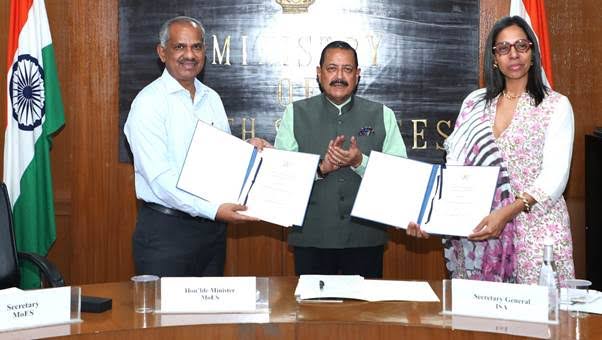


Dr Singh highlighted that the contract aligns with the government’s Deep Ocean Mission, launched by Prime Minister Narendra Modi, which emphasizes seabed mineral exploration, advanced mining technology development, and strengthening India’s Blue Economy initiatives. “By securing exclusive rights for PMS exploration at the Carlsberg Ridge, India consolidates its leadership in deep-sea research, enhances maritime presence, and builds national capacity for future resource utilization,” he said.
Polymetallic Sulphides are rich in critical metals such as copper, zinc, iron, silver, gold, and platinum, formed from hydrothermal processes on the ocean floor. These resources hold immense strategic and commercial potential, attracting global attention and positioning India at the forefront of the international seabed exploration community.
Dr Singh recalled India’s longstanding partnership with ISA, noting that the country was the first to receive a polymetallic nodule exploration area in international waters and was recognized as a “Pioneer Investor.” With contracts now covering the Central Indian Ridge, Southwest Indian Ridge, and Carlsberg Ridge, India leads in PMS exploration both in scale and scope.
The minister also announced that India will host the 8th ISA Annual Contractors Meeting in Goa from 18–20 September 2025, underlining its leadership role in global seabed exploration. “India’s 30-year association with ISA has been a source of pride, and we remain committed to working closely to deliver on the mandate for the common heritage of humankind,” Dr Singh said.
Dr M. Ravichandran, Secretary of the Ministry of Earth Sciences, highlighted that the MoES and the National Centre for Polar and Ocean Research (NCPOR), Goa, view this contract as a major achievement. “This makes India the first ISA member state to hold two PMS exploration contracts, with the largest global area allocated for such work,” he stated. He added that India aims to generate scientific knowledge of unexplored seabed ecosystems while ensuring the sustainable and responsible utilization of mineral resources.
Significance for India’s Blue Economy
This achievement not only boosts India’s strategic presence in the Indian Ocean but also supports the broader Blue Economy framework. Deep-sea mineral exploration is expected to provide critical raw materials for industries, advance maritime technology, and generate scientific insights into ocean ecosystems, all while contributing to sustainable economic growth.