
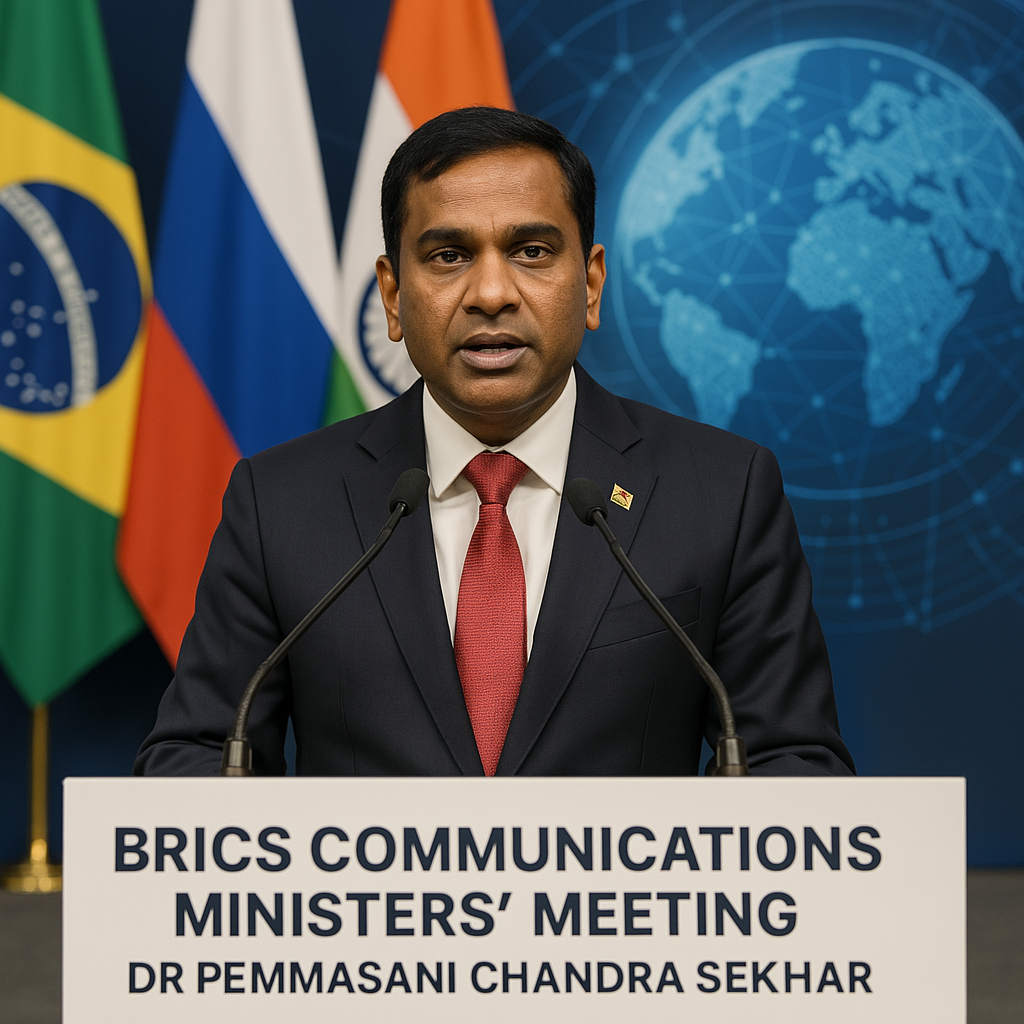
Brasília, Brazil, 3 June 2025 — India reaffirmed its commitment to inclusive and sustainable digital transformation at the 11th BRICS Communications Ministers’ Meeting held in Brasília. Representing the nation, Dr. Pemmasani Chandra Sekhar, Minister of State for Communications and Rural Development, showcased India’s Digital Public Infrastructure (DPI) as a global benchmark for inclusive governance and technological innovation.
The meeting, hosted under Brazil’s BRICS presidency, focused on themes such as universal and meaningful connectivity, space sustainability, environmental protection, and a future-ready digital ecosystem. In line with these, Dr. Sekhar presented India’s digital journey, highlighting the nation’s efforts to bridge the digital divide and promote equitable growth.
India’s DPI: A Model for the World
Dr. Sekhar emphasized the success of flagship initiatives like Aadhaar and Unified Payments Interface (UPI). Aadhaar has empowered over 950 million Indians with a secure digital identity, while UPI now accounts for 46% of the world’s real-time digital transactions, revolutionizing the way Indians make payments.
He attributed this progress to the leadership of Prime Minister Narendra Modi, under whom India has built a scalable, inclusive, and innovative digital ecosystem. Dr. Sekhar invited BRICS countries to deepen collaboration on DPI and leverage interoperable platforms to promote financial inclusion, transparency, and innovation.
Strong Cybersecurity, Trust, and Safety
Highlighting India’s commitment to digital trust, he spoke about initiatives such as Sanchar Saathi, which helps citizens combat telecom fraud. He also stressed the importance of cybersecurity, data protection, and user trust in an increasingly interconnected digital world.
India’s Telecommunications Act and Data Protection Act, along with robust digital skill development programs and a thriving startup ecosystem, were also showcased as pillars of its digital governance framework.
Affordable and Widespread Connectivity
India’s efforts to expand digital infrastructure have been significant. Dr. Sekhar mentioned the Digital Bharat Nidhi programme, which funds key initiatives like BharatNet, now connecting over 2.18 lakh village councils via optical fiber.
India’s indigenous development and rollout of 4G and 5G technologies now provide high-speed internet to over 95% of the population via 4G and more than 80% via 5G. With the lowest mobile data cost globally (just 12 cents per GB), India is leading the world in affordable digital access.
Leading the Way in Space and Environmental Sustainability
Space sustainability also featured in Dr. Sekhar’s address. He noted that space is no longer a distant frontier but a key part of modern digital infrastructure. India has implemented reforms in SATCOM regulation and is pushing for global cooperation on orbital equity, spectrum governance, and space traffic management.
On the environmental front, Dr. Sekhar pointed out the massive challenge of e-waste, citing projections of 82 billion kg by 2030. He advocated for circular economy models, green energy adoption, and digital sustainability, drawing attention to India’s leadership through the Green Development Pact (introduced at the G20) and the Panchamrit commitments from COP26.
Final Declaration and Looking Ahead
Dr. Sekhar welcomed the Final Declaration adopted by BRICS nations, which promotes cross-border digital innovation and sustainability. He praised the unity and clarity of vision shown by member nations and reaffirmed India’s belief that BRICS is a collaborative platform, not just a forum.
Concluding his speech, he invited all BRICS countries to participate in the 12th Communications Ministers’ Meeting, which India will host in 2026. Echoing the ancient Indian ethos of “Vasudhaiva Kutumbakam”—the world is one family—Dr. Sekhar reiterated India’s commitment to One Earth, One Family, One Future, a theme central to global digital cooperation.