 India’s Statement at the Ministerial Forum
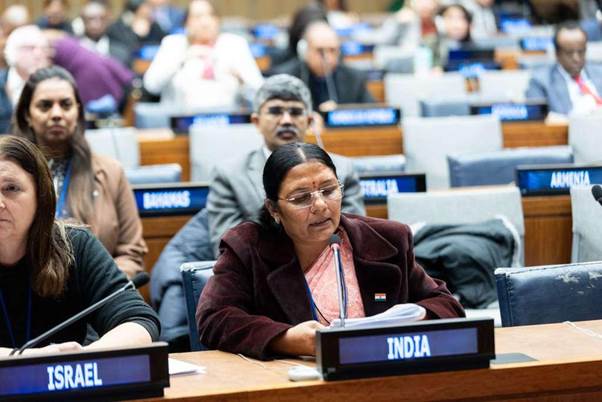
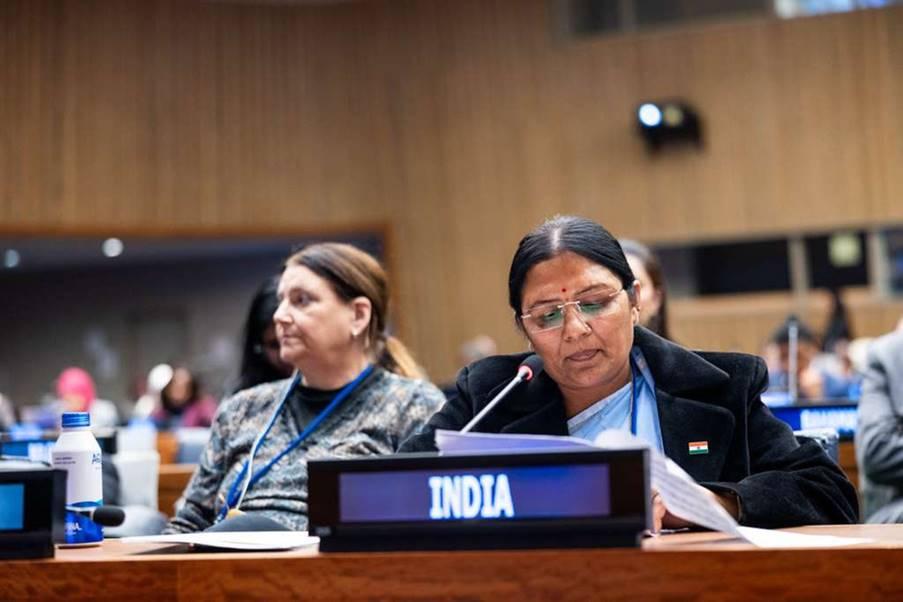
Delivering India’s statement, Minister of State for Women and Child Development Smt. Savitri Thakur addressed the Ministerial Forum themed “Leveraging the outcomes of the Second World Summit for Social Development from Copenhagen to Doha: Mobilizing National Action towards 2030 and beyond.” She underlined that India’s development approach places people at the core of policymaking, echoing the spirit of the Copenhagen Declaration and the Doha Political Declaration.
The Minister noted that while global challenges have evolved over the decades, the fundamental principle of people-centric development continues to guide India’s governance philosophy. According to her, inclusive growth, social equity and dignity for all remain non-negotiable pillars of India’s public policy framework.
Sabka Saath, Sabka Vikas as a Governance Philosophy
Smt. Thakur highlighted that India’s guiding mantra of “Sabka Saath, Sabka Vikas” reflects a whole-of-government and whole-of-society approach. This framework, she said, ensures that development outcomes reach every section of society, particularly the most vulnerable.
She stressed that the approach is not limited to welfare delivery but is rooted in rights-based empowerment, enabling citizens to actively participate in and benefit from economic and social progress.
Scale of Social Protection and Inclusion
Outlining the scale of India’s social protection systems, the Minister shared that over 800 million people are covered under national food security programmes. These initiatives, she said, have played a crucial role in ensuring nutritional security and reducing vulnerability among low-income households.
She also highlighted that more than 550 million citizens have access to free healthcare services through an extensive network of health and wellness centres across the country. In addition, affordable medicines and medical devices are being made available through nearly 16,000 Jan Arogya Kendras, significantly reducing out-of-pocket healthcare expenses.
Women’s Empowerment and Grassroots Democracy
Women’s empowerment featured prominently in India’s presentation. The Minister pointed out that over 1.45 million elected women representatives currently serve in local self-governments, reflecting India’s strong commitment to grassroots democracy and gender-inclusive governance.
Flagship initiatives such as Beti Bachao Beti Padhao and Sukanya Samriddhi Yojana were cited as key instruments strengthening education, financial security and social status of girls. Labour reforms promoting equal pay, safe working environments and enhanced workforce participation of women were also highlighted.
Inclusion of Vulnerable and Marginalised Groups
Smt. Thakur emphasised that India’s inclusive development agenda extends to vulnerable and marginalised communities. Large-scale collateral-free loans have enabled millions of women entrepreneurs and street vendors to enter the formal economy, fostering financial independence.
Targeted schemes such as the SMILE initiative are supporting the rehabilitation and social inclusion of transgender persons and other disadvantaged groups, ensuring that development benefits are shared equitably.
Digital Public Infrastructure and Last-Mile Delivery
The Minister underscored that India’s development journey is increasingly powered by digital public infrastructure. Tools such as direct benefit transfers, interoperable digital platforms and citizen participation mechanisms have improved transparency and ensured efficient last-mile delivery of services.
These reforms, she noted, have strengthened trust between citizens and institutions while enhancing the effectiveness of social programmes.
Global Partnerships and Shared Responsibility
Reaffirming India’s civilisational ethos of “Vasudhaiva Kutumbakam” the world is one family Smt. Thakur expressed India’s readiness to deepen global partnerships. She said India remains willing to share its development experiences and best practices with other nations to collectively advance social justice.
The session witnessed active participation from a majority of UN Member States, reflecting broad international engagement on social development priorities.
Bilateral Engagement with Sweden
Following the ministerial session, Smt. Thakur also held a courtesy meeting with H.E. Ms. Camilla Waltersson Grönvall, Minister for Social Services of Sweden. The interaction focused on shared perspectives on social inclusion and welfare-oriented governance.