
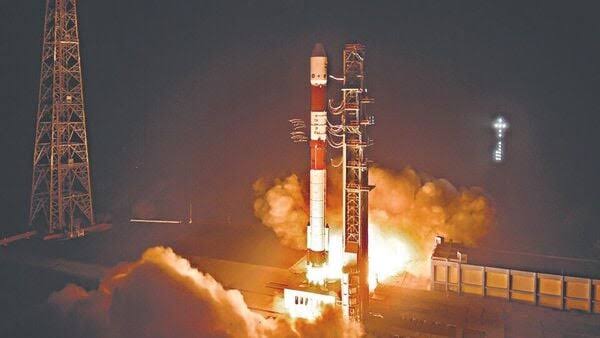
India’s space agency, ISRO, has achieved a significant milestone by successfully conducting its first-ever space docking experiment. The Space Docking Experiment (SpaDeX) marked a historic moment for India, as it became only the fourth country to master this complex technology after the United States, Russia, and China.

Docking Procedure and Significance
The process required precise coordination, as the Chaser and Target spacecraft needed to align in the same orbit and gradually close the gap between them. On Thursday morning, scientists carefully reduced their relative speeds, bringing the two crafts to just 3 meters apart before latching and screwing their connectors together. This created an airtight passage, enabling the safe transfer of materials or crew between the spacecraft.
ISRO chief S. Somanath, who oversaw the mission before his recent retirement, described the docking as “a highly complex process demanding extreme precision.”
The docking technology is vital for India’s ambitions to build a space station and facilitate long-term lunar missions. Over the next few days, ISRO will test power transfer between the two spacecraft, simulating servicing scenarios in space. The mission will also conduct undocking and separation trials.
Scientific Advances
Apart from docking, the mission is carrying 24 payloads for experiments, including seed germination in microgravity. ISRO confirmed that cowpea seeds have successfully sprouted in space, a breakthrough for potential food production on long-duration missions.
Another key feature is a robotic arm capable of handling space debris and assisting in future missions like Chandrayaan-4, which aims to collect and return lunar soil samples.
Prime Minister’s Remarks
Prime Minister Narendra Modi, present at ISRO’s Bengaluru office during the docking, praised the mission as a “monumental step” for India’s space exploration. He emphasized its importance for the country’s future space goals.
With SpaDeX, India reaffirms its position as a rising leader in global space technology, paving the way for ambitious interplanetary missions and advanced spac estation development.