
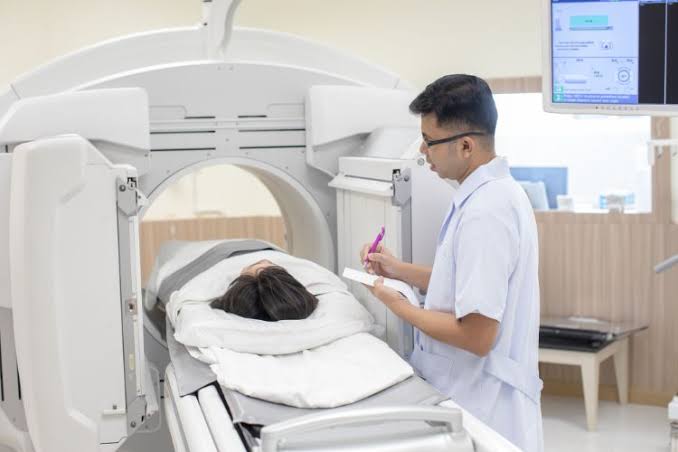
India is making strategic moves to bridge the gap in the supply of key medical radioisotopes, essential for cancer diagnostics and treatment. In a recent reply in Parliament, Union Minister Dr. Jitendra Singh revealed critical insights into the country’s current production capabilities, existing shortages, and future plans.
What Are Medical Radioisotopes?
Medical radioisotopes are radioactive materials used in nuclear medicine. They help in diagnosing and treating serious conditions like cancer, heart disease, and thyroid disorders. Common isotopes include Lu-177, I-131, Mo-99, and F-18.


India’s main producer of radioisotopes, the Board of Radiation & Isotope Technology (BRIT), is a key unit of the Department of Atomic Energy (DAE). BRIT supplies radiation-based products and services for healthcare, agriculture, and research.
Here’s how domestic production currently stands:
- Lutetium-177 (Lu-177): 1000–1200 Curie – Meets ~85–90% of demand
- Iodine-131 (I-131): 1000–1200 Curie – Supply not sufficient
- Molybdenum-99 (Mo-99): 8000–10000 Curie – Shortage exists
- Fluorine-18 (F-18): 300–400 Curie – Not sufficient due to short half-life
Notably, Ga-68 supply remains stable with no reported mismatch.
Why the Shortage Exists
Fluorine-18 has a short half-life of just 110 minutes. That makes storage and transport extremely difficult. As a result, F-18 can only be supplied to hospitals located near the production facilities in Parel (Mumbai) and other selected centers.
Similarly, Mo-99 and I-131 face production shortfalls, creating a demand-supply mismatch that affects patients in need of critical nuclear medicine procedures.


PPP-Based Isotope Reactor: A Ray of Hope
To address these shortages, the Bhabha Atomic Research Centre (BARC) has received in-principle approval for a new PPP-based isotope reactor project. The Detailed Project Report (DPR) is currently under review for administrative and financial clearance.
This state-of-the-art reactor is expected to start operations around 2035. It will have a production capacity of 0.5 MCi (million Curie), significantly boosting India’s radioisotope output.
Expanding Access to Nuclear Medicine
The Tata Memorial Centre (TMC), also under DAE, has taken proactive steps to decentralize nuclear medicine services. TMC has expanded infrastructure in Tier-2 and Tier-3 cities to provide affordable cancer care.
Cities with newly developed nuclear medicine units include:
- Tier-2 Cities: New Chandigarh, Visakhapatnam, Bhubaneswar, Guwahati, Varanasi, Muzaffarpur (Bihar)
- Tier-3 City: Sangrur (Punjab)
This decentralization ensures that patients in smaller towns do not have to travel to metros for life-saving diagnostics or treatment.
India’s Nuclear Medicine Future
The challenges in radioisotope availability are serious but not insurmountable. The government’s multi-pronged approach — from strengthening BRIT’s production to launching a dedicated isotope reactor — shows its commitment.
Additionally, ISRO’s ongoing efforts to expand science infrastructure and TMC’s decentralization model can together form the backbone of a strong, self-sufficient nuclear medicine ecosystem in India.
Conclusion: Action with a Vision
The shortage of Mo-99, I-131, and F-18 highlights the urgent need to enhance isotope production. The planned reactor, expected by 2035, is a crucial part of the solution. Meanwhile, India continues to meet most of the demand for Lu-177 and remains committed to making nuclear healthcare accessible to all.
As Dr. Jitendra Singh emphasized in Parliament, the government will continue to act with urgency and foresight to meet national healthcare needs in the nuclear domain.