
In a moment of national pride and scientific advancement, India has announced its first-ever space biology experiments to be conducted aboard the International Space Station (ISS). The groundbreaking mission will focus on studying the sustainability of human life in space, marking a significant milestone under the BioE3 Biotechnology policy launched by Prime Minister Narendra Modi. The initiative was unveiled by Union Minister Dr. Jitendra Singh, who expressed heartfelt optimism about India’s rising role in global space and biotechnology research.

Led by the Indian Space Research Organisation (ISRO) and the Department of Biotechnology (DBT), these experiments will be part of the upcoming AXIOM-4 mission, with Indian astronaut Group Captain Shubhanshu Shukla as a crew member. It’s a proud moment for the country as it takes confident strides towards understanding life beyond Earth.
The first of the two key experiments will explore how microgravity and space radiation affect the growth of edible microalgae—an incredibly nutrient-rich food source with potential for long-term space missions. These microscopic algae, rich in proteins and bioactive compounds, could play a vital role in ensuring both nutrition and environmental balance in spacecraft. Their fast growth rate and high oxygen output make them promising candidates for life support systems during extended space journeys.
The second experiment will investigate cyanobacteria like Spirulina and Synechococcus, studying their ability to thrive in microgravity using urea- and nitrate-based growth media. The goal is to explore these organisms not only as “superfoods” rich in proteins and vitamins but also as key players in recycling carbon and nitrogen from human waste, helping achieve a self-sustaining life-support system in space.
Dr. Jitendra Singh emphasized that these experiments are more than scientific achievements—they represent India’s compassionate and innovative approach to creating sustainable futures, both on Earth and beyond. The collaboration between ISRO, NASA, and DBT speaks to the spirit of global cooperation, while India’s scientists, engineers, and researchers continue to pave the way for new possibilities.
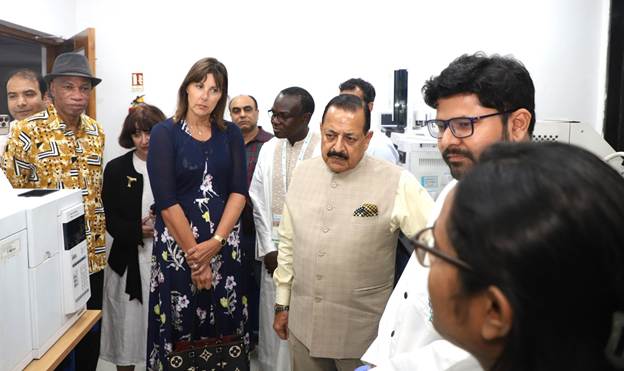
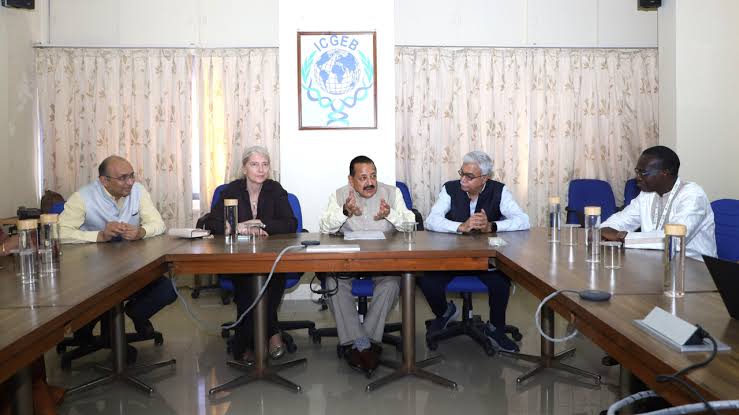
These advancements are being supported by the newly inaugurated DBT-ICGEB Biofoundry at the International Centre for Genetic Engineering and Biotechnology in New Delhi. The facility, developed with cutting-edge technologies in synthetic biology and biotechnology, is set to become a hub for designing and building high-performance biological systems that benefit not just space exploration but also food, health, and environmental sustainability on Earth.
Dr. Singh also acknowledged the visionary leadership of Prime Minister Modi, whose focus on the BioE3 policy—Biotechnology for Economy, Environment, and Employment—has laid the foundation for India’s global leadership in the biotech sector. This policy supports innovation in areas like climate-resilient agriculture, smart proteins, bio-based chemicals, and now, space research.
As India prepares to send its experiments into orbit, the nation stands united in anticipation and pride. These pioneering steps are not just about technology—they reflect a deeper commitment to understanding life, nurturing innovation, and contributing to the well-being of future generations across the universe.