
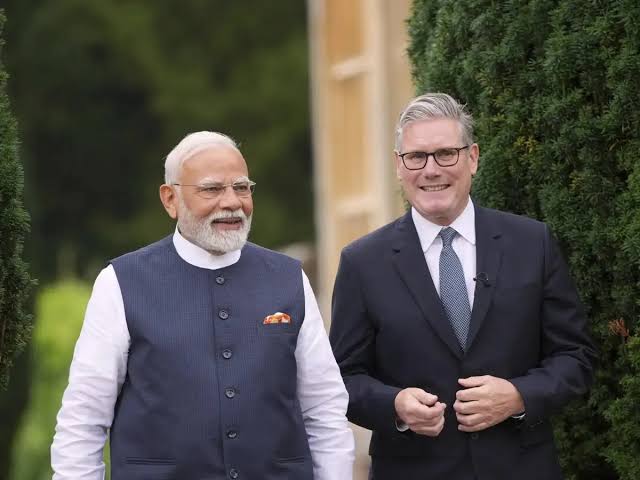
India and the United Kingdom have signed a landmark Comprehensive Economic and Trade Agreement (CETA), ushering in a new era of cooperation and shared prosperity. Signed under the visionary leadership of Prime Minister Narendra Modi and UK Prime Minister Sir Keir Starmer, the agreement promises to boost trade, employment, and global competitiveness for both nations.
Zero-Duty Access for 99% of Indian Exports
The heart of the India-UK CETA is about opening doors. Nearly 99% of Indian goods will now enjoy zero-duty access to the UK market. This covers almost 100% of trade value, giving Indian exporters a competitive edge across a wide product spectrum.
Labour-intensive sectors like textiles, leather, footwear, gems and jewellery, marine products, sports goods, and toys stand to benefit the most. These industries support millions of jobs in India, especially among women, artisans, and MSMEs.


By offering unprecedented market access, CETA fuels the ‘Make in India’ initiative. Indian manufacturers and exporters will now enjoy wider exposure to one of the world’s most mature consumer markets. The ripple effect will be felt across local supply chains, raw material producers, packaging firms, logistics operators, and technology providers.
Big Win for Indian Services Sector
For the first time, the UK has made ambitious commitments in services. The agreement provides access across key sectors like:
- IT and IT-enabled services
- Financial and legal services
- Education and business consulting
- Telecom, engineering, and architecture
This creates high-value opportunities for Indian firms and professionals. With simplified work visas and fast-track processes, Indian experts like chefs, yoga instructors, engineers, and musicians can now work in the UK with ease.


Double Contribution Convention: A Financial Relief
One of the biggest breakthroughs is the Double Contribution Convention (DCC). Under this agreement, Indian workers and employers will be exempt from social security contributions in the UK for up to three years.
This means more take-home pay for professionals and lower costs for Indian businesses. It enhances India’s talent competitiveness and makes it easier for firms to send their experts abroad.
Empowering MSMEs, Women, and Youth
CETA is inclusive by design. The agreement opens new pathways for MSMEs, startups, women entrepreneurs, farmers, and youth to join global value chains. Special provisions address sustainable practices, innovation, and non-tariff barriers.
By simplifying processes and reducing red tape, CETA allows more small businesses to tap into international markets.
Aim to Double Bilateral Trade by 2030
India-UK trade currently stands at USD 56 billion. With CETA in place, the two countries aim to double this volume by 2030. The agreement creates a strong foundation to expand trade in both goods and services while promoting innovation, collaboration, and cultural exchange.
Leaders Speak: Vision and Gratitude
Mr. Piyush Goyal, India’s Minister for Commerce and Industry, thanked Prime Minister Modi for his unwavering commitment and stated:
“This agreement is a historic step. It covers 99% of Indian exports, improves professional mobility, and includes the innovative Double Contribution Convention. CETA will empower artisans, farmers, MSMEs, and startups while protecting our core national interests.”
UK Prime Minister Sir Keir Starmer echoed this sentiment, highlighting the UK’s goal to deepen ties with fast-growing economies and build long-term partnerships.
Inclusive Growth through Global Collaboration
CETA is not just about trade figures. It’s about jobs, growth, skills, and inclusion. It reflects a shared vision of building economies that are resilient, fair, and future-ready.
The agreement sends a powerful signal to the world — that India and the UK are committed to free, open, and equitable trade that benefits all sections of society.