 Sovereign AI Under the IndiaAI Mission
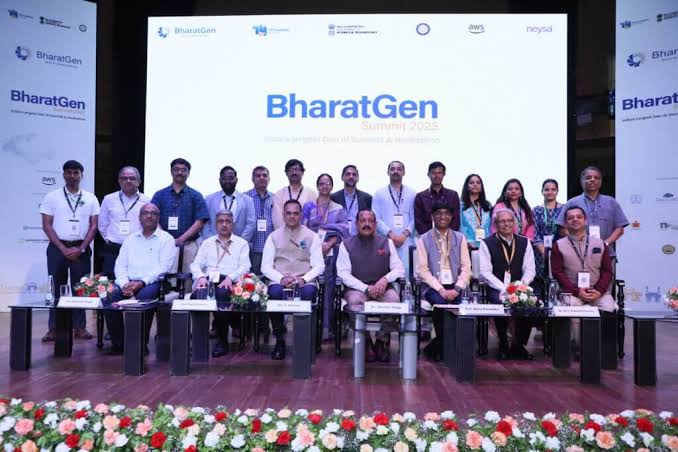
Replying to a starred question during Question Hour, Dr. Jitendra Singh said Bharat GenAI is a core outcome of the IndiaAI Mission, launched in March 2024. The initiative has been conceptualised as a national foundational model, ensuring strategic autonomy in artificial intelligence at a time when AI capabilities are increasingly shaping economic and governance outcomes.
The Minister underlined that sovereignty in AI does not imply isolation. Instead, Bharat GenAI is envisioned as an open yet safeguarded platform, with mechanisms being developed for data sharing, access controls and pricing for different categories of users.
Text, Speech and Vision Capabilities
Bharat GenAI has been structured around three primary technological pillars—text, speech and vision—along with domain-specific applications. While text models in all 22 scheduled languages are expected to be completed within the month, speech and vision capabilities have already been developed in 15 Indian languages.
Dr. Singh informed the House that these capabilities will continue to expand over time. He added that the programme is dynamic by design, allowing for the inclusion of dialects, regional variants and additional languages as more high-quality datasets become available.
Domain Applications Tailored for India
Beyond general-purpose language capabilities, Bharat GenAI is also being developed for targeted sectoral use. The Minister said domain-specific applications are being built for areas such as agriculture, Ayurveda and the legal system, where contextual understanding and linguistic accuracy are critical.
These applications are expected to support farmers, practitioners of traditional medicine and legal professionals by improving access to information, advisory services and language-sensitive digital tools.
Consortium-Led Development Model
On the institutional framework behind the project, Dr. Jitendra Singh said the Bharat GenAI consortium is being spearheaded by IIT Bombay. Several other premier institutions, including IIT Hyderabad, IIT Madras, IIT Kanpur, IIT Mandi and IIT Indore, are also participating.
The consortium-based approach reflects what the Minister described as a “whole-of-science” and “whole-of-nation” model. He stressed that the initiative is not region-specific and will continue to broaden its institutional base as the ecosystem matures.
Innovation Hubs and AI Compute Infrastructure
The Minister also highlighted the broader ecosystem supporting India’s AI ambitions. As part of the national innovation framework, 25 technology innovation hubs have been established to work on emerging technologies such as artificial intelligence, robotics, machine learning and cybersecurity.
Four of these hubs located at IIT Indore, IIT Kanpur, IIT Dhanbad and the Indian Institute of Science, Bengaluru have been upgraded to enable closer co-location of industry and academia, facilitating faster technology transfer.
Compute Access and Private Sector Participation
Acknowledging concerns over the availability of high-end computational resources such as graphics processing units, Dr. Singh said the IndiaAI Mission includes a dedicated compute pillar. This pillar is designed to provide shared access to advanced computing infrastructure at subsidised rates for eligible users.
He added that private sector participation is being actively encouraged, citing the recent launch of a ₹1 lakh crore Research, Development and Innovation funding initiative. The funding framework is expected to support AI-related infrastructure and projects that are closer to real-world deployment.
Inclusive Expansion and the Road Ahead
Responding to questions on representation from the North-Eastern region, the Minister said the ecosystem is continuously evolving. He noted that languages from the region are already included among the 22 scheduled languages, and institutional participation will widen further over time.
Concluding his reply, Dr. Jitendra Singh said Bharat GenAI is intended as a continuously evolving national capability rather than a one-time exercise. The emphasis, he said, would remain on inclusiveness, linguistic authenticity and adaptability to technological change.