
India’s Food Processing Sector: A Rural Growth Story
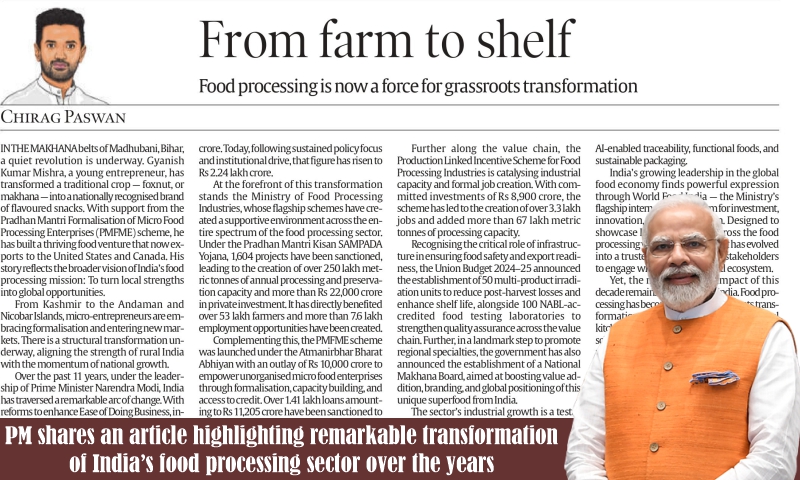
India’s food processing industry is not just growing—it’s thriving. Over the past few years, it has emerged as a major force behind rural development, entrepreneurship, and job creation. Prime Minister Narendra Modi recently highlighted this transformation, responding to Union Minister Chirag Paswan’s post showcasing the sector’s dynamic rise.

From Farm to Global Shelf
India has transitioned from merely producing raw agricultural products to adding value through modern food processing. Today, the country exports ready-to-eat meals, organic goods, spices, and dairy to global markets.
In fact, as per Invest India, the sector contributes nearly 13% to the manufacturing GDP. Moreover, it is projected to grow at a CAGR of 10.8% by 2028, signaling a strong global demand for Indian food products.
Rural Entrepreneurs Lead the Way
Schemes such as the PMFME (PM Formalisation of Micro Food Processing Enterprises) and ODOP (One District One Product) have changed the lives of thousands of rural families. These programs offer support to micro-units and encourage local innovation.
For example, women-led SHGs in Uttar Pradesh are now packaging pickles, jaggery, and millet-based snacks, reaching customers across India and even overseas.
This kind of localized entrepreneurship strengthens both income and identity.
Policy Support Drives Expansion
Government policies have accelerated the sector’s transformation. Unlike earlier times, new food businesses now receive better funding, infrastructure, and training.
Some notable schemes include:
-
Mega Food Parks that provide built-in infrastructure for processing units.
-
The PLI (Production Linked Incentive) Scheme, which rewards larger food manufacturers for output and investment.
-
The Agri Infrastructure Fund, which promotes cold chains and rural storage.
Because of these initiatives, over ₹11,000 crore has already flowed into food processing. These efforts have also created more than 3 lakh direct and indirect jobs.
Boosting Farmers’ Income
Farmers are finally seeing the benefits. When their produce gets processed locally, they earn more and waste less. The direct supply chains to food processors have increased efficiency and reduced middlemen.
In addition, MSMEs working in the sector receive guidance on food safety, digital sales, and export protocols. These efforts ensure they can compete with national and international players.
India’s Food Products Go Global
India’s food items—especially millets (Shree Anna), spices, and herbal teas—are winning hearts abroad. The International Year of Millets (2023) helped increase global awareness and boost exports.
In FY24, India’s processed food exports touched $7.3 billion, reflecting growing global trust in Indian products.
Conclusion: Rural Kitchens, Global Impact
India’s food processing boom is changing lives at the grassroots. It’s not just about factories—it’s about local kitchens becoming global brands. With strong government backing, rural creativity, and modern tools, this sector is redefining India’s economic landscape.
PM Modi’s recent acknowledgment of the sector isn’t just symbolic—it highlights a blueprint for self-reliance, sustainability, and rural empowerment.