
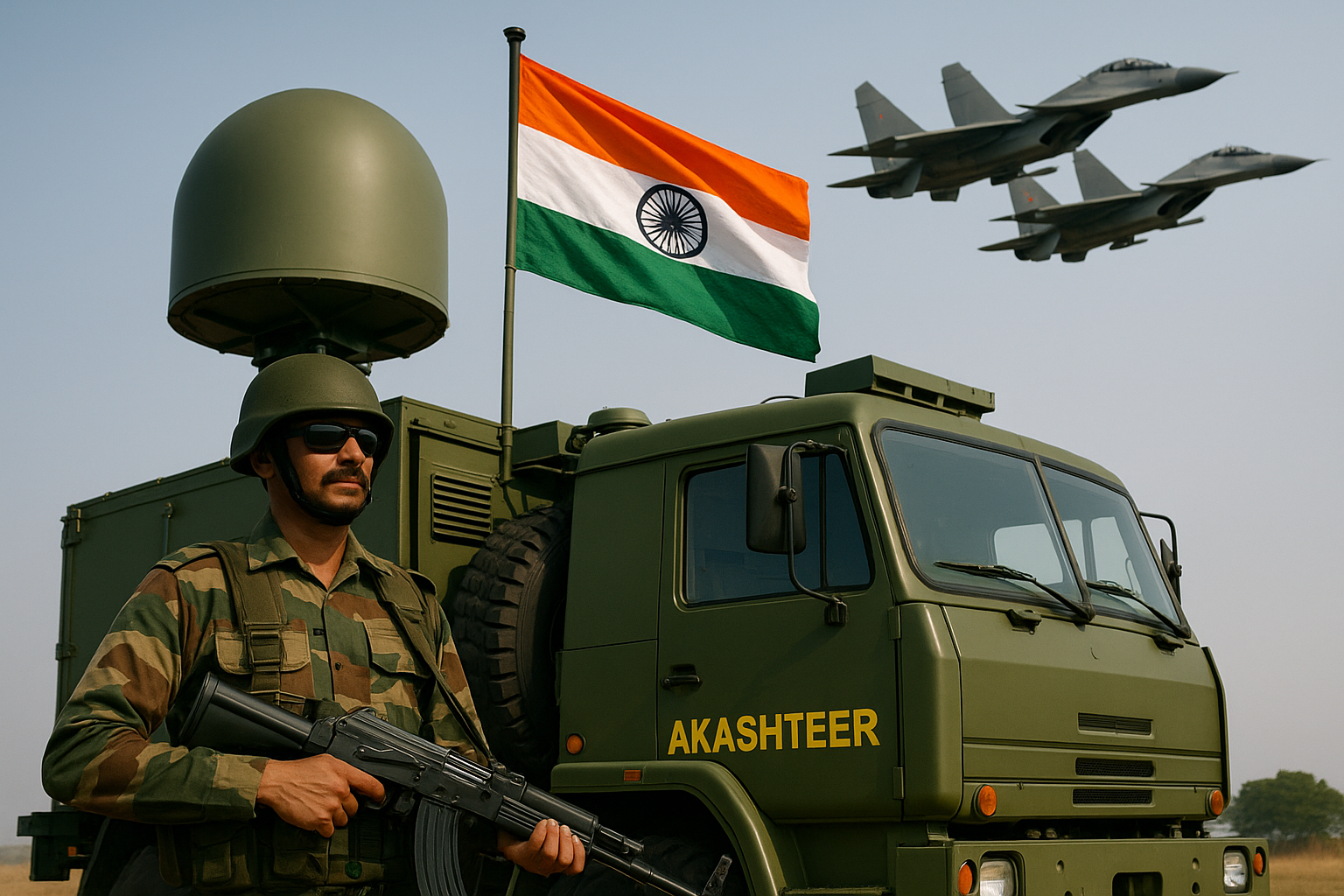
India’s Road to Defense Autonomy – Akashteer & Beyond
Atmanirbhar Bharat – From Dependency to Independence: India’s Defense Evolution
For decades, India relied on foreign nations for critical military supplies. Jets, submarines, missiles—most were imported, often with delays and long-term dependency.
However, that story is changing. India is now investing in systems made by its own engineers, tested in its own terrain, and tuned to its own needs.
Akashteer, the indigenous radar-based air defense system, is one such milestone. It represents not just a technical upgrade—but a paradigm shift in India’s military narrative.
Akashteer: The Breakthrough System
Akashteer was developed by Bharat Heavy Electricals Ltd. (BHEL), a trusted Indian defense contractor. This system helps the Army and Air Force coordinate real-time radar data to intercept and destroy aerial threats like drones or loitering munitions.
In Operation Sindoor, Akashteer proved its capability by neutralizing over 300 enemy drones within hours. That wasn’t just a tactical victory—it was a strategic demonstration of what India can build itself.
Moreover, it uses automation and artificial intelligence for faster threat detection and autonomous response. As soon as a drone enters the radar zone, the system identifies, locks, and fires.
Why Defense Autonomy Matters Now
Defense independence is no longer a patriotic slogan. It’s a necessity. Here’s why:
-
Supply Chain Control – No delays due to foreign approvals.
-
Tailored Technology – Systems are customized for India’s geography and warfare needs.
-
Cost Savings – Billions saved in long-term procurement.
-
Export Potential – Opens new geopolitical influence channels.
As India’s Ministry of Defence outlines, this self-reliance is core to the vision of Atmanirbhar Bharat—a movement toward complete national capability.
Beyond Akashteer: What Else is India Building?


India is not stopping at one system. The list of indigenous developments is expanding fast:
-
Tejas Mk1A – A multirole fighter jet now attracting export interest
-
DRDO Anti-Drone Tech – Deployed at G20 and Independence Day for security
-
PINAKA Rocket Launcher – Used in recent live fire drills
-
Arjun Mk1A Tank – Optimized for desert warfare
-
DRDO Drones – Under trial for surveillance and loitering strike roles
Each of these projects shows how India is reducing reliance on imports—and building systems it could one day sell to others.
Export Shift: India as a Defense Partner
As global tensions rise, many smaller nations want affordable and independent defense options. India now has a shot at being that alternative.
Unlike the U.S., Russia, or China, India offers technology without political strings. With proven systems like Akashteer, it could soon become a preferred partner for nations in Africa, Southeast Asia, and the Middle East.
In fact, recent interest from Vietnam, Philippines, and Egypt in Indian platforms confirms this growing trend.
Yes, There Are Challenges
India’s progress is notable, but not without hurdles:
-
Bureaucratic red tape
-
Global competition from long-established players
-
Scaling R&D for production
-
Complex export clearance protocols
Still, each success—like Akashteer—builds trust and credibility. More importantly, it proves India’s ability to deliver under pressure.
Conclusion: The Autonomy Era Is Here
India’s path to defense autonomy is no longer a distant dream. From intercepting drones with Akashteer to showcasing new tank and missile systems, India is becoming a defense power—not just a customer.
The next decade may well see India emerge as a net exporter of military technology.