
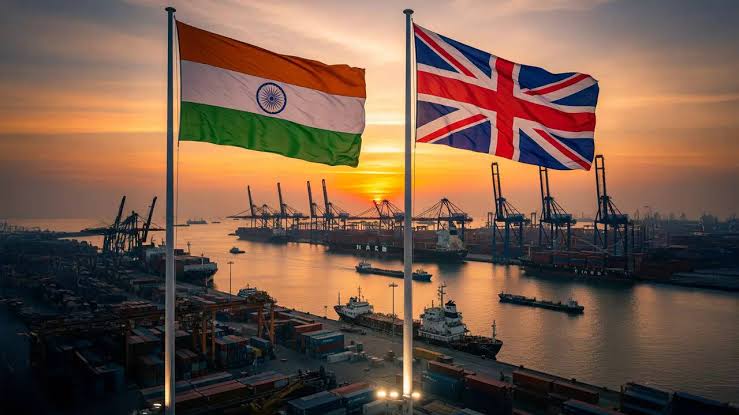
The signing of the India–UK Comprehensive Economic and Trade Agreement (CETA) on July 24, 2025, marks a game-changing moment. With this deal, tariffs on 99% of traded goods have been eliminated. For Indian marine exports, this means a powerful entry into the UK market — duty-free.
A Milestone for Indian Seafood Exporters
Until now, Indian shrimp, lobsters, and squid faced UK tariffs as high as 21.5%. These duties made Indian products less competitive than those from Vietnam and Singapore, who already enjoyed Free Trade Agreements (FTAs) with the UK.
But not anymore. With CETA in place, India joins that elite club. It now enjoys 100% tariff elimination on seafood under critical HS Codes 03, 05, 15, 1603/1604/1605, 23, and 95.
This boosts India’s competitive edge and makes its marine exports more attractive to UK buyers.


In 2024–25, India’s total seafood exports touched $7.38 billion (₹60,523 crore), with frozen shrimp alone earning $4.88 billion — that’s 66% of total revenue.
The UK imported $104 million worth of Indian seafood last year. Of this, shrimp accounted for $80 million — about 77%.
With CETA’s zero-duty access, industry estimates now predict a staggering 70% surge in Indian seafood exports to the UK in the next few years.
New Opportunities for Coastal States
The fisheries sector supports over 28 million Indians, especially in coastal states like Andhra Pradesh, Kerala, Tamil Nadu, Maharashtra, and Gujarat.
These states already lead in seafood production and export. Now, with CETA, they can scale up further — especially in high-value, value-added products such as breaded shrimp, ready-to-cook squid rings, and frozen fish fillets.
Efforts to meet UK’s Sanitary and Phytosanitary (SPS) standards are already underway. Compliance will ensure smooth exports and continued access to the premium UK market.
From Bulk to Brilliance: Rise in Value-Added Exports
Over the past decade, India’s seafood export story has evolved. From 10.51 lakh metric tonnes in 2014–15 to 16.85 lakh metric tonnes in 2024–25, volume grew 60%.
But value grew even faster — from ₹33,441 crore to ₹62,408 crore, an 88% jump.
Even more promising: value-added exports have tripled to ₹7,666 crore. This shows India’s growing focus on processed, high-quality marine products — a segment highly preferred by UK consumers.
India vs. Global Competitors: Level Playing Field
Before CETA, India lagged behind Vietnam and Singapore, who already had FTAs with the UK. Now, that gap is gone.
Indian seafood can now compete on equal footing — both in pricing and quality.
India’s production strength, skilled workforce, and traceability systems give it a clear advantage. Exporters can now diversify beyond the US and China and build stronger ties with the UK market.
Positive Ripple Effect for Coastal Livelihoods
This trade deal is not just about numbers. It’s about people.
Fisherfolk, seafood processors, transporters, and exporters — millions stand to gain.
With increased export demand, employment in coastal communities is likely to rise. Better returns for their catch mean better lives for India’s fishing families.
India’s Sustainable Seafood Dream
India contributes nearly 8% of global fish production. With the right policies, infrastructure, and sustainable practices, it can become a global leader in ethical marine trade.
The CETA agreement helps accelerate this vision — by offering a premium, regulation-driven market like the UK for Indian seafood.
Conclusion: A Big Catch for India
India–UK CETA is a landmark for India’s seafood sector. Tariff-free access to the UK makes Indian shrimp, squid, pomfret, and lobsters more affordable and appealing to British buyers.
Coastal states are ready. Exporters are optimistic. With the UK now wide open, India is ready to make a bigger splash in global seafood markets.