


The Nari Shakti Vandan Adhiniyam, enacted in 2023, represents the biggest milestone in women’s political participation. The law provides one-third reservation for women in the Lok Sabha and State Legislative Assemblies, including Delhi. This measure is expected to significantly increase the number of women lawmakers and enhance their participation in shaping policy and governance.
Equal Opportunity Through Labour Code Reforms
Beginning 21 November 2025, the four consolidated labour codes Code on Wages, Industrial Relations Code, Code on Social Security and the Occupational Safety, Health and Working Conditions Code came into force. These laws rationalise 29 previous labour regulations and explicitly prohibit gender-based discrimination in wages and employment.
Notably, the reforms permit women to work in all sectors, including night shifts, underground mining and heavy machinery roles, provided employers ensure safety and obtain consent. This marks a significant expansion of opportunities for women in traditionally male-dominated fields.
Strengthening Workplace Safety Through the SHe-Box Portal
The government has also enhanced mechanisms to address workplace harassment. The SHe-Box portal, aligned with the Sexual Harassment of Women at Workplace Act, serves as a unified platform for submitting complaints and tracking their status.
Available in 22 Indian languages, the portal ensures accessibility for women across rural and remote areas. Complaints filed on the portal are automatically forwarded to the Internal or Local Committees concerned, enabling quick redressal and accountability.
Criminal Law Reforms Prioritise Women’s Safety
The new criminal laws Bharatiya Nyaya Sanhita, Bharatiya Nagarik Suraksha Sanhita and Bharatiya Sakshya Adhiniyam effective from July 2024, consolidate and strengthen provisions related to crimes against women and children. Offences such as sexual exploitation on false promises, organised crime, child trafficking and gang rape now carry stricter punishments and mandatory minimum sentencing.
Victim-centric reforms, including e-FIR, zero FIR and witness protection provisions under BNSS, aim to improve reporting and support for survivors. Additionally, the redefined scope of electronic evidence under BSA enhances protection against digital harassment.
Boosting Women in STEM, Skills and Entrepreneurship
The government continues to expand women’s presence in science and technology through initiatives like the Women Scientist Scheme, Vigyan Jyoti and Overseas Fellowship Programme. Skill development programmes under Skill India, PM Kaushal Kendras and PMGDISHA have further enabled women to acquire employability-focused competencies.
Day-NRLM has mobilised nearly 10 crore women through 90 lakh self-help groups, reshaping rural economic landscapes. In urban areas, the NULM supports women’s livelihood creation. Schemes like MUDRA, Stand-Up India, Start-up India and PM SVANidhi have widened credit access, with women forming a majority of beneficiaries.
Safety, Support and Social Protection Under Mission Shakti
Mission Shakti, the umbrella scheme for women’s safety and empowerment, includes One Stop Centres, the national women’s helpline 181 and several support services. Under Beti Bachao Beti Padhao, awareness campaigns against gender bias and child marriage have driven positive behavioural change, encouraging greater value for the girl child.
Sakhi Niwas provides safe accommodation for working women, while Shakti Sadan supports distressed women and trafficking survivors. The Palna component facilitates childcare services, enabling mothers to participate in the workforce.
Healthcare Access Through Ayushman Bharat
Ayushman Bharat has emerged as a major pillar of women’s health, offering over 141 dedicated medical packages for women. Screening for major diseases, including breast and cervical cancer, is provided through Health and Wellness Centres across the country. Affordable access to essential women-centric medicines, including Suvidha sanitary napkins at ₹1 per pad, is available through more than 16,000 Janaushadhi Kendras.
Financial Inclusion and Social Security
Schemes such as Sukanya Samriddhi Yojana, PMJJBY, PMSBY, APY and NSAP have significantly improved long-term financial security for women. Government procurement policy mandating 3% sourcing from women-owned MSMEs has offered a strong boost to women-led enterprises.
Promoting Gender-Inclusive Communication
The government’s Guide on Gender-Inclusive Communication, launched in November 2023, seeks to address linguistic biases and promote respectful, inclusive language in public discourse. This cultural shift aims to transform attitudes and social norms over time.
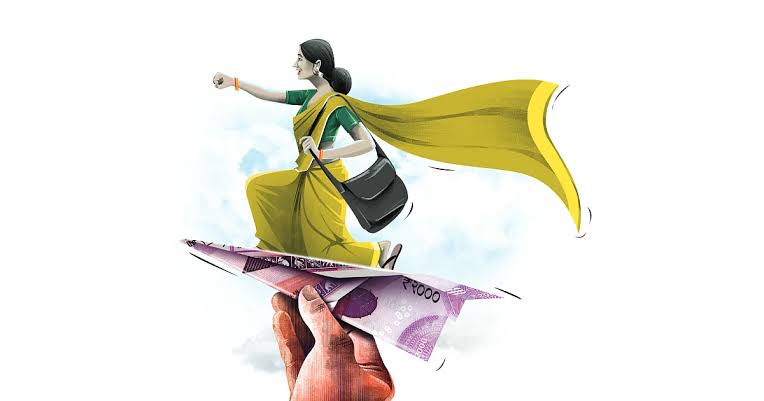
Together, these measures reflect a decisive national movement towards women-led development, positioning women not just as beneficiaries of policy but as drivers of India’s progress.