
Historic Journey Nears End
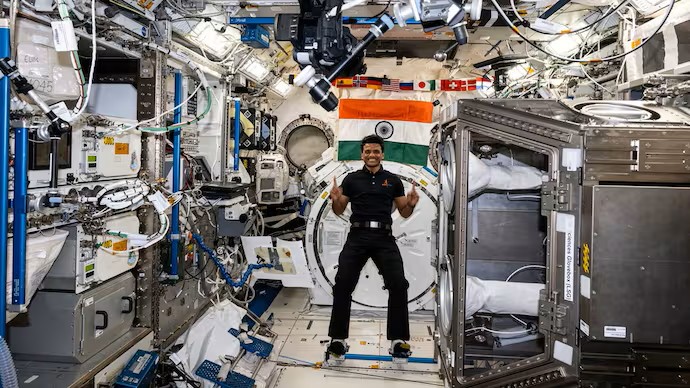
Indian astronaut Shubhanshu Shukla has officially begun his return to Earth after an 18-day stay aboard the International Space Station (ISS). He, along with three other astronauts from the Axiom-4 mission, undocked from the ISS on July 14, 2025, around 4:50 PM IST.
The return journey, aboard the SpaceX Dragon spacecraft, is expected to last nearly 22.5 hours. The crew will splash down off the coast of California on July 15 at approximately 3 PM IST.
A Milestone for Indian Spaceflight
Shukla is only the second Indian astronaut to fly to space, after Rakesh Sharma in 1984. His mission marks a historic collaboration between ISRO, NASA, and Axiom Space.
He was joined by Slawosz Uznański-Wiśniewski (Poland), Tibor Kapu (Hungary), and Peggy Whitson (USA). Whitson, a veteran astronaut and now Axiom’s human spaceflight director, commanded the mission.


During the mission, the crew performed over 50 experiments. Shubhanshu Shukla’s research focused on how muscles and bones deteriorate in microgravity. He also explored sustainable food sources by cultivating microalgae for long-duration missions.
Other studies covered plant biology, cancer cells, and even mental health in space. The team also analyzed how blood circulation adapts to zero gravity.
Cargo and Scientific Samples
The SpaceX Dragon spacecraft is also carrying back over 250 kg of cargo. This includes scientific samples, equipment, and experiment data that will be studied further on Earth.
Family Watches from Lucknow
Back in India, Shukla’s family in Lucknow eagerly awaits his safe return. His father, Shambhu Dayal Shukla, shared how Shubhanshu gave them a virtual tour of life in space.
“He showed us where he lives, works, and sleeps. In space, people float—there’s no walking,” his father said. His mother, Asha Devi, offered prayers at a temple on the first Monday of Sawan for his safe return.
Global Collaboration in Orbit
This mission highlighted growing global collaboration in space research. NASA, ISRO, ESA, and private players like Axiom and SpaceX worked together. A NASA statement called it “a fulfilment of the joint commitment between U.S. President Donald Trump and Indian Prime Minister Narendra Modi.”
The mission launched on June 25 from NASA’s Kennedy Space Center in Florida. Just 24 hours later, the crew reached the ISS and began their research.
Beyond the Mission
While Shukla’s mission is nearing its end, its impact will be long-lasting. His participation paves the way for future ISRO astronaut missions and inspires a new generation of Indian scientists.
The experiments on microalgae and muscle atrophy are especially important for upcoming missions like Gaganyaan and long-term Moon or Mars explorations.
Final Thoughts
As India’s space ambitions grow, missions like Axiom-4 bridge the gap between government agencies and private innovation. Shubhanshu Shukla’s journey is a testament to India’s readiness for advanced space exploration.
When the Dragon capsule splashes down, it will carry not only astronauts but also hope, discovery, and global unity.