
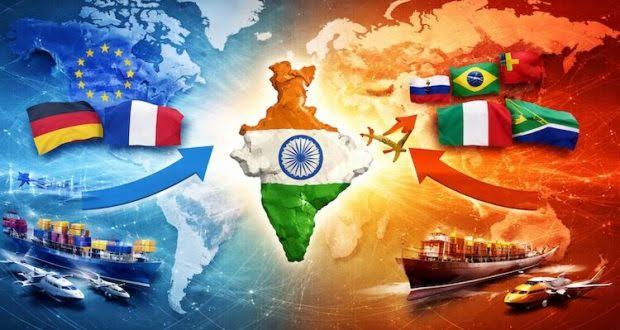

The most significant milestone this year is the conclusion of negotiations for the India-European Union Free Trade Agreement in January 2026. Dubbed the “Mother of All Deals,” the agreement creates a modern, rules-based framework aimed at deeper market integration.
The pact grants preferential access across 97 percent of EU tariff lines, covering 99.5 percent of trade value. Immediate duty elimination will apply to 70.4 percent of tariff lines, benefiting key labour-intensive sectors such as textiles, leather, footwear, gems and jewellery, tea, coffee, and marine products.
The EU has also offered commitments across 144 services subsectors, including IT, education, and business services, giving Indian service providers greater certainty and access in European markets.
New FTAs with UK, Oman and New Zealand
In FY 2025-26, India concluded major trade agreements with the United Kingdom, Oman and New Zealand, marking a broad geographic expansion of its trade strategy.
The India-UK Comprehensive Economic and Trade Agreement provides duty-free access to nearly 99 percent of India’s exports to the UK. It also includes a Double Contribution Convention, eliminating dual social security payments and generating significant savings for Indian professionals working in Britain.
India’s Comprehensive Economic Partnership Agreement with Oman grants zero-duty access on over 98 percent of Oman’s tariff lines. Notably, Oman extended commitments on traditional medicine, creating opportunities for India’s AYUSH and wellness sectors.
The India-New Zealand FTA eliminates duties on 100 percent of tariff lines for Indian exports and includes an investment commitment of USD 20 billion over 15 years. The agreement enhances prospects for farmers, MSMEs and skilled professionals.
Strengthening Existing Agreements
India’s earlier agreements continue to deliver measurable gains. The India-UAE CEPA has already pushed bilateral trade past USD 100 billion in FY 2024-25. Non-oil exports, including electrical machinery and smartphones, have recorded strong growth since the pact came into force.
The India-Australia Economic Cooperation and Trade Agreement has expanded preferential access across all Australian tariff lines, with Indian exports to Australia rising by 8 percent in FY 2024-25. Agricultural exports, chemicals and gems and jewellery have posted notable gains.
The India-European Free Trade Association (EFTA) agreement, effective from October 2025, stands out for linking trade liberalisation with an investment commitment of USD 100 billion over 15 years. The agreement is expected to generate one million direct jobs in India.
Domestic Reforms Boost Export Competitiveness
Trade agreements are supported by domestic policy reforms aimed at enhancing export competitiveness. The Trade Connect ePlatform now provides exporters with real-time information on tariff concessions under various FTAs.
The Export Promotion Mission and credit guarantee schemes offer financial stability and liquidity support, particularly during periods of global uncertainty. The Reserve Bank of India has extended export credit tenors and expanded the timeline for repatriation of export proceeds to strengthen exporter resilience.
Additionally, the Union Budget 2026-27 introduced measures such as easing courier export caps, extending duty-free input imports for footwear and seafood processing, and enabling electronic sealing for faster cargo clearance directly from factories.
Expanding Negotiation Agenda
Beyond concluded agreements, India has launched fresh negotiations with the Gulf Cooperation Council and completed the first round of talks for an Israel FTA. Discussions are also expanding with ASEAN, Mexico and Canada, signalling sustained momentum in trade diplomacy.
As global supply chains realign and economic blocs evolve, India’s diversified trade partnerships are strengthening its position as a reliable and competitive global player. The expanding network of FTAs is not only widening market access but also generating jobs, boosting investment and reinforcing India’s integration into global value chains.