
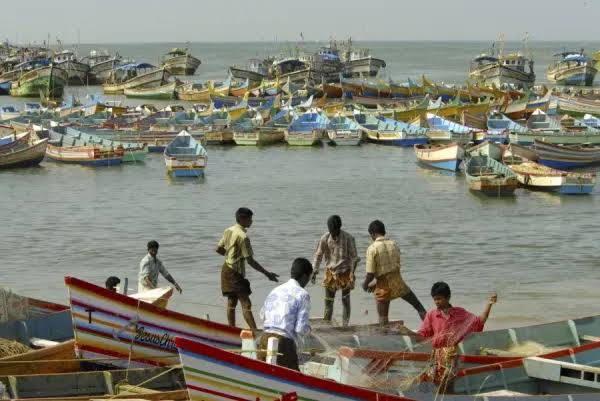
India’s fisheries sector, long regarded as a subsistence-driven activity, is undergoing a decisive transformation into a growth-oriented Blue Economy engine, powered by institutional finance, digital integration, and targeted policy support. Recognised as a “Sunrise Sector,” fisheries now contribute 1.12 per cent to the country’s Gross Value Added and sustain the livelihoods of nearly three crore people across coastal, inland, and island regions.
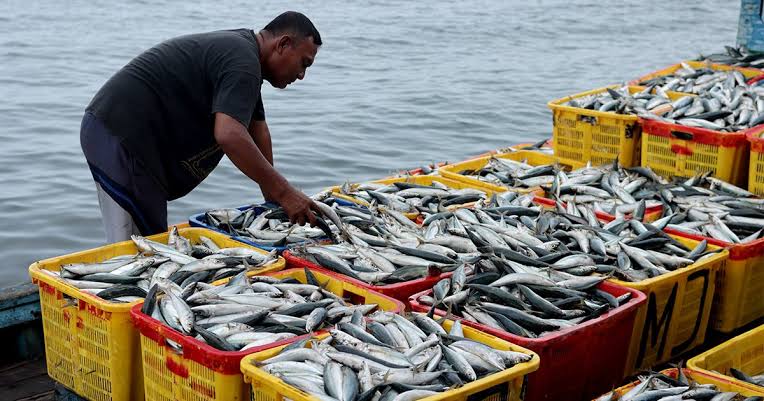

India’s fisheries production reached an all-time high of 197 lakh tonnes in FY 2024–25, nearly doubling from 95.79 lakh tonnes recorded in 2013–14. This surge has been driven largely by inland fisheries, which now contribute more than 75 per cent of total output, marking a structural shift from capture-based fishing to culture-based aquaculture.
The country’s extensive natural assets, including an 11,099-kilometre-long coastline and one of the world’s largest networks of rivers, reservoirs, wetlands, and floodplains, have provided a strong foundation for this expansion.
Rising Exports and Policy Push
Fisheries have also emerged as a major foreign exchange earner. In FY 2024–25, seafood exports touched ₹62,408 crore, with frozen shrimp accounting for the largest share. The United States and China remained key export destinations, reinforcing India’s position in global seafood markets.
Policy interventions such as the reduction of GST on key fish products from 12 per cent to five per cent have further boosted domestic consumption and international competitiveness, while sustained public investment has strengthened value-chain infrastructure.
Digital Integration Through NFDP
A defining feature of the sector’s modernisation has been the launch of the National Fisheries Digital Platform (NFDP), designed to address the challenges of a fragmented stakeholder base. The single-window digital architecture now hosts registrations of nearly 30 lakh stakeholders, offering access to institutional credit, insurance, cooperative services, markets, and welfare schemes.
The platform has enabled fishers and entrepreneurs to apply for loans remotely, select activity-specific financing, and track applications in real time, significantly reducing procedural barriers.
Expanding Access to Institutional Credit
Despite rapid growth, access to affordable finance has remained a key constraint at the grassroots level. Investment needs vary widely, from micro-credit of ₹50,000 for small fishers to capital-intensive funding exceeding ₹10 crore for large processing and infrastructure projects.
To address this diversity, the Department of Fisheries has collaborated with banks to design customised lending products. As of June 2025, 4.76 lakh Kisan Credit Cards for Fisheries have been issued, with disbursements exceeding ₹3,214 crore, offering interest rates as low as four per cent on timely repayment.
Infrastructure Funds and Risk Mitigation
Long-term financing is being supported through the Fisheries and Aquaculture Infrastructure Development Fund, which has a corpus of ₹7,522 crore and remains operational until March 2026. The fund provides a three per cent interest subvention, lowering effective borrowing costs and encouraging investments in cold chains, processing units, ice plants, and harbour infrastructure.
To further de-risk lending, a dedicated ₹750 crore Credit Guarantee Fund managed by NABSanrakshan offers collateral-free coverage for loans up to ₹12.5 crore, improving lender confidence.
Financial Inclusion and Capacity Building
Under the PM-Matsya Sampada Yojana, borrowers are also eligible for a one-time post-disbursement incentive to offset documentation costs. More than 19,000 loan requests have already been submitted through the NFDP, with hundreds approved and disbursed across a wide credit spectrum.
Parallel efforts are underway to strengthen financial literacy through credit camps and training programmes for bankers in collaboration with NABARD, BIRD, and MANAGE.
Towards a Resilient Blue Economy
The convergence of digital platforms, interest-subvented loans, and risk-mitigation mechanisms marks a shift from subsidy-led support to credit-driven growth. Institutional finance is increasingly enabling sustainable scaling, climate resilience, and market integration across the fisheries value chain.
- As India targets fish production of 220 lakh tonnes by FY 2025–26, strengthened financial architecture is expected to play a decisive role in ensuring inclusive prosperity and global competitiveness.