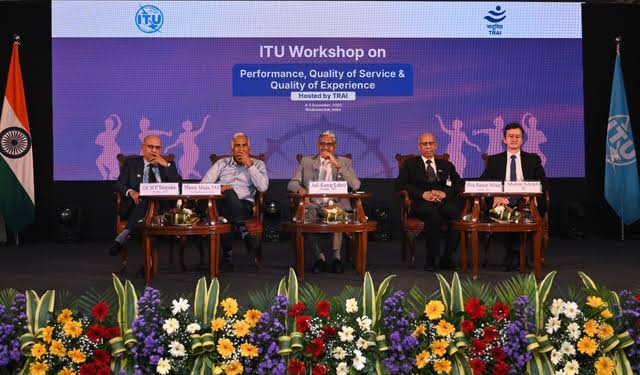
The Telecom Regulatory Authority of India (TRAI), in collaboration with the International Telecommunication Union (ITU), opened a two-day international workshop in Bhubaneswar today, focusing on performance, Quality of Service (QoS) and Quality of Experience (QoE) in the telecom sector.
Shri Chaudhary noted that discussions on connectivity mapping, satellite-based quality measurement, and regional regulatory strategies would help strengthen digital service delivery across countries.
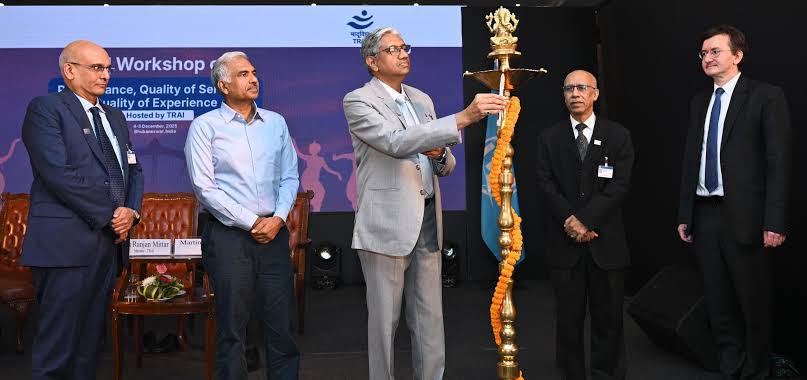 Leaders Highlight India’s Digital Transformation Journey
Union Minister of State for Communications, Dr. Pemmasani Chandra Sekhar, addressed participants through a video message. He reaffirmed India’s commitment to delivering reliable, high-quality telecom connectivity and stressed that the Telecommunications Act, 2023, places strong emphasis on improving service standards.
Another video message from Mr. Seizo Onoe, Director of ITU’s Telecommunication Standardization Bureau, highlighted the global relevance of harmonised QoS norms in reducing digital inequality. He assured ITU’s continued support in strengthening national-level QoS and QoE regulations.
Odisha Government Emphasises Telecom’s Role in Public Safety
Odisha Chief Secretary Shri Manoj Ahuja underlined how telecom infrastructure forms the backbone of disaster management, public safety systems and welfare programme delivery. Drawing from Odisha’s history of cyclones and tsunami alerts, he said that dependable connectivity is essential for inclusive development.
“Telecom now underpins nearly every public service from panchayat governance to welfare schemes,” he said, adding that strong, collaborative efforts are essential to improving service delivery across states and nations.
TRAI Chairman Calls for Stronger Regional Collaboration
In his inaugural address, TRAI Chairman Shri Anil Kumar Lahoti highlighted India’s rapid strides in digital connectivity, noting the world’s fastest 5G rollout, over 1.23 billion subscribers and near-universal 4G coverage. He said India has emerged as a model for developing economies in bridging rural–urban digital gaps.
He also pointed to TRAI’s new Quality of Service Rating Framework for Buildings, aimed at improving indoor connectivity where a majority of India’s data usage occurs. Shri Lahoti proposed exploring an ITU Regional Group for Asia dedicated to QoS and QoE frameworks, especially for fraud prevention, interoperability and cybersecurity.
Global Delegates Share Tools and Models for Service Quality
Study Group Advisor Mr. Martin Adolph thanked TRAI and the Odisha government, stating that discussions from the workshop would directly inform upcoming ITU QSDG work. The event featured four themed sessions on satellite-service performance, connectivity mapping, measurement tools and regional regulatory practices.
Representatives from Asia, Africa and Europe including Opensignal, Ookla and Keysight Technologies exchanged methodologies and regulatory strategies to strengthen global telecom networks. The programme will continue tomorrow with the Quality of Service Development Group meeting and ITU-T Study Group 12 deliberations on a global “NRA Repository”.