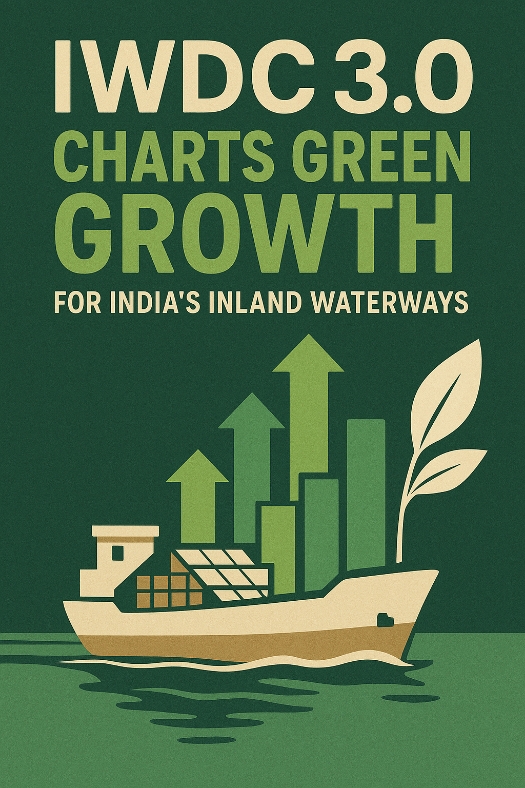
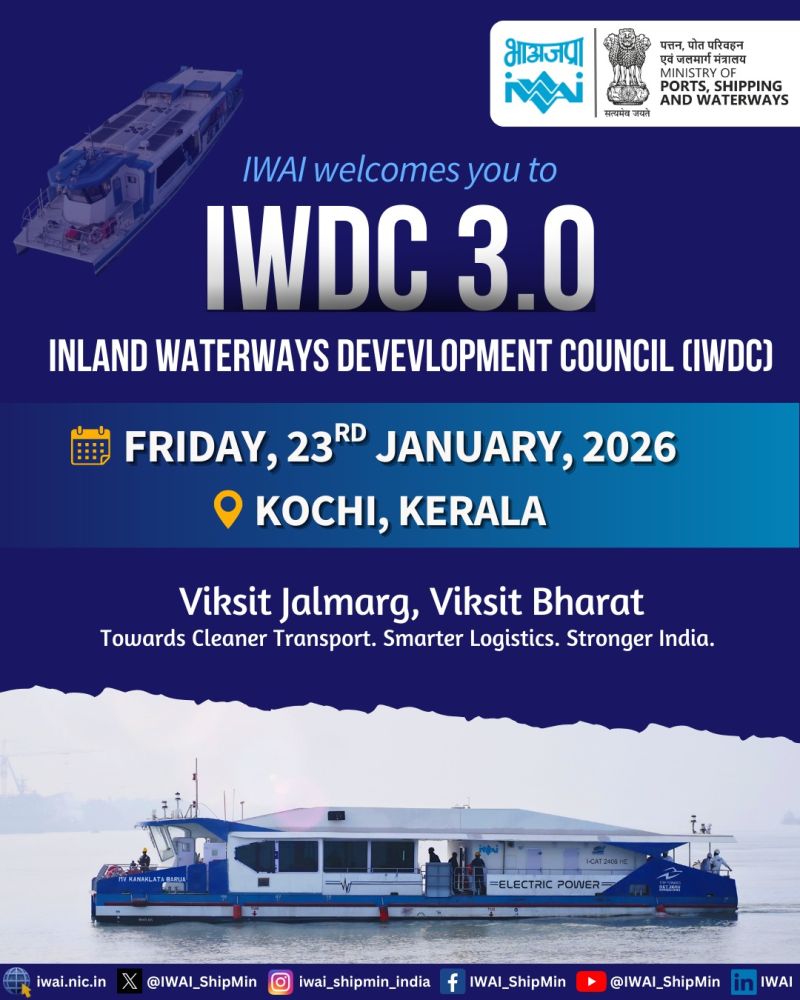
During IWDC 3.0, several State Support Agreements are expected to be signed, strengthening Centre-State collaboration on IWT projects. The agenda includes sessions on building resilient urban water transport systems, improving cargo efficiency, promoting green passenger vessels, advancing river cruise tourism, and implementing digital and sustainable practices. The council will also review regulatory frameworks and address state-level concerns regarding ongoing and proposed inland water projects.
 Expanding India’s Inland Waterways Network
India’s inland waterways span 111 national waterways across 23 states and four union territories, of which 32 are operational for cargo and passenger transport. The Inland Waterways Authority of India (IWAI) under the Ministry of Ports, Shipping and Waterways oversees their development, maintenance, and regulation. Cargo movement has surged from 18 million tonnes in 2013-14 to 145.84 million tonnes in 2024-25, while passenger traffic reached 7.64 crore in 2024-25, highlighting the sector’s rapid growth.
Transformative initiatives such as the ‘Jalvahak’ Cargo Promotion Scheme incentivize shippers to shift freight from road and rail to waterways, while the ‘Jal Samriddhi’ program encourages private sector participation in terminal development and operations. These efforts have made inland waterways a more fuel-efficient and environmentally friendly alternative, easing pressure on overburdened road and rail networks.
Assam and the Brahmaputra: A Model of Sustainable Transport
Assam has emerged as a success story under IWDC’s coordinated policy approach. National Waterway 2 (Brahmaputra) with multimodal terminals at Pandu and Jogighopa, permanent terminals at Dhubri and Bogibeel, and floating terminals along its course, now handles over 98% of Assam’s inland waterways cargo, including vehicles, construction materials, and over-dimensional freight. The NW2 corridor benefits from assured depth maintenance from the Bangladesh border to Sadiya.
The government has earmarked ₹5,000 crore for inland waterways development in the Northeast from 2025 to 2030, with projects worth ₹1,152 crore already under implementation. IWDC 3.0 will focus on operationalizing the Dibrugarh Regional Centre of Excellence, completing the Pandu ship-repair facility, and scaling green vessel operations. Infrastructure projects such as the Bogibeel River Port access road and a tourist jetty at Uzan Bazaar Ghat are expected to be announced, alongside plans to develop 85 jetties across Assam.
Looking Ahead: A Green, Tech-Driven Inland Water Transport
According to Sunil Paliwal, Chairman of IWAI, “IWDC has become a national platform aligning Centre-State priorities, translating policy into actionable outcomes, and promoting a greener, more efficient transport ecosystem. By integrating infrastructure development with sustainability and community participation, we are reviving India’s riverine heritage and positioning inland waterways as a preferred mode for cargo and passengers.”
IWDC 3.0 is expected to consolidate progress from IWDC 1.0 in 2024 and IWDC 2.0 in 2025, accelerating project execution and scaling technology-driven inland waterways in close collaboration with states. The meeting is positioned as a strategic forum to evaluate inland waterways’ potential and advantages, supporting India’s goals for sustainable and efficient transport networks.