
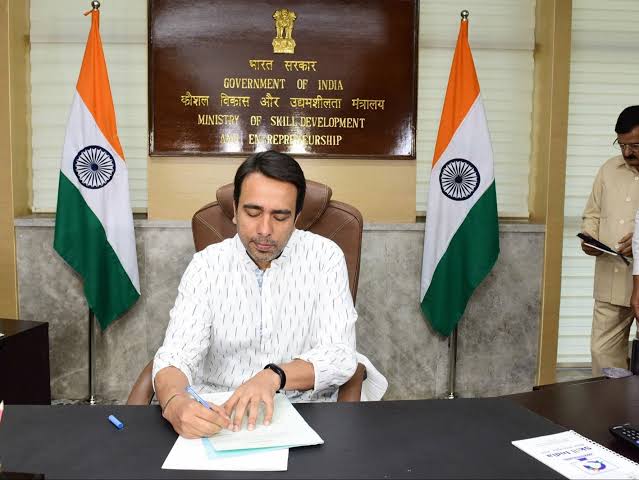
Union Minister of State (Independent Charge) for Skill Development and Entrepreneurship and Minister of State for Education, Shri Jayant Chaudhary, on Friday underscored the critical role of industry–government collaboration in building a future-ready workforce. Chairing a high-level industry interaction in Mumbai, the Minister said sustained partnerships are essential to address skill mismatches and create aspirational vocational pathways for India’s youth.
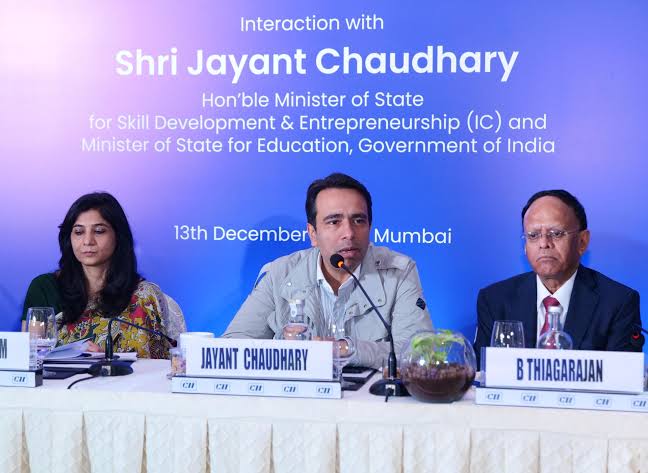

Addressing participants from sectors including education, healthcare, hospitality, banking and manufacturing, Shri Jayant Chaudhary noted that India stands at a crucial juncture. Rapid technological advancements, evolving workplace models and demographic shifts are significantly reshaping skill requirements across industries.
He pointed out that despite a large youth workforce, employers continue to face difficulties in finding job-ready talent. This persistent gap, he said, highlights the urgent need for deeper and more structured collaboration between industry and government.
Centres of Excellence for Advanced Skilling
The Minister outlined the government’s ambition to establish a coherent national framework for Centres of Excellence (CoEs) focused on advanced skills, industry relevance and measurable employment outcomes. These CoEs, he explained, are envisioned as anchors for high-end skilling, trainer excellence and curriculum innovation.
He emphasised that industry demand must guide curriculum design and training delivery, ensuring that skilling initiatives remain responsive to real-world workforce needs.
PM-SETU to Transform ITIs Nationwide
Highlighting the flagship PM-SETU scheme—Pradhan Mantri Skilling and Employability Transformation through Upgraded ITIs—the Minister described it as a systemic reform to reposition Industrial Training Institutes as modern, aspirational and outcome-driven institutions.
With an estimated outlay of Rs. 60,000 crore, PM-SETU aims to upgrade 1,000 government ITIs into industry-aligned Centres of Excellence. The scheme will operate through a hub-and-spoke model, linking 200 hub ITIs with 800 spoke ITIs to scale quality vocational education across the country.
Industry-Led Governance Model
A key feature of PM-SETU is industry-led governance through a Special Purpose Vehicle (SPV). The SPV will oversee financial management, infrastructure and equipment upgrades, monitoring and evaluation, and stakeholder engagement.
“By embedding industry participation in curriculum design, trainer exposure, apprenticeships and placements, we are creating ITIs that are directly aligned with labour market needs, both domestic and global,” Shri Jayant Chaudhary said.
Global Mobility and Apprenticeships
The Minister also highlighted the strategic role of Skill India International Centres in supporting global mobility. He urged industry leaders to actively partner in operationalising these centres as gateways for international-standard training and overseas employment opportunities.
Referring to the Cabinet’s approval of India’s participation in the World Economic Forum’s Skill Accelerator, he said the initiative would help align India’s skilling ecosystem with global best practices and future workforce trends.
Measuring Employability and Lifelong Learning
Emphasising transparency and outcomes, Shri Jayant Chaudhary underlined the importance of the Employability Matrix as a standardised index to assess job readiness across sectors. He also highlighted the growing relevance of APAAR IDs and the Academic Bank of Credits in enabling flexible learning pathways and lifelong upskilling.
On apprenticeships, he reiterated the government’s focus on expanding participation under the National Apprenticeship Promotion Scheme and the National Apprenticeship Training Scheme, calling apprenticeships a critical bridge between education and employment.
Industry Voices Call for Co-Creation
Setting the context for discussions, MSDE Economic Advisor Smt. Archana Mayaram highlighted the widening disconnect between industry demand and available skills. She noted that changing workforce expectations, especially among Gen-Z, make it essential to raise the aspirational value of skills and create visible pathways to stable employment.
CII Chairman Mr. B. Thiagarajan stressed that industry must act as a co-creator in the skilling ecosystem. Mr. Ashank Desai, Chairman of Mastek, called for evolving collaborative skilling models to keep pace with rapid technological change.
Towards a Future-Ready Workforce
During the interactive session, industry stakeholders exchanged views on strengthening industry-led skilling models, modernising training institutions and expanding apprenticeships. Participants agreed that stronger placement linkages and aligned training programmes can significantly improve enrolment and employment outcomes.
The deliberations concluded with a shared view that sustained collaboration between government and industry will be critical to building a skilled, confident and globally competitive workforce to support India’s economic growth.