
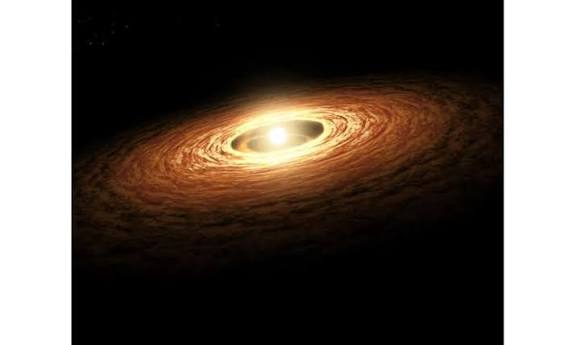

Typically, the dense inner wall of a circumstellar disk shields its outer regions from intense ultraviolet radiation emitted by the star. This shielding makes it difficult to detect PAHs, complex carbon-based molecules considered key precursors to life, especially around low-mass, Sun-like stars.
However, JWST observations in 2022 captured a rare moment when the inner wall of T Chamaeleontis’s disk partially collapsed due to a sudden burst of accretion. This collapse allowed ultraviolet photons to flood previously shadowed regions of the disk, illuminating chemical signatures that had long remained hidden.
JWST Confirms Presence of Ancient Molecules
Scientists from the Indian Institute of Astrophysics (IIA), an autonomous institute under the Department of Science and Technology, analysed archival JWST Mid-Infrared Instrument (MIRI) data to study the molecular composition of the disk.
The findings revealed strong PAH emission bands in the mid-infrared range between 5 and 15 microns. According to researchers, this makes T Chamaeleontis one of the lowest-mass stars known to host detectable PAHs in its circumstellar disk.
“It was like a curtain lifting, revealing chemistry that had been hidden for years,” said Arun Roy, a post-doctoral fellow at IIA and lead author of the study published in The Astronomical Journal.
Comparing JWST with Spitzer Data
To better understand the evolution of these molecules, researchers revisited archival observations from NASA’s Spitzer Space Telescope dating back to 2002. Although Spitzer detected only faint PAH signatures, the comparison confirmed that the molecules were present even before the disk’s inner wall collapsed.
Importantly, while JWST revealed much stronger signals, the relative intensities of the PAH features remained nearly unchanged over two decades. This suggests that the molecules themselves remained chemically stable, despite dramatic changes in disk illumination.
Implications for Planet Formation Studies
The study indicates that the PAHs in T Chamaeleontis are relatively small molecules, consisting of fewer than 30 carbon atoms. Their survival through dynamic disk changes strengthens the idea that complex organic chemistry can persist even in turbulent planet-forming environments.
With JWST expected to continue observations for years, astronomers plan to revisit the system multiple times to track how molecular chemistry evolves alongside disk structure. Such studies could significantly refine existing models of planetary system development.