
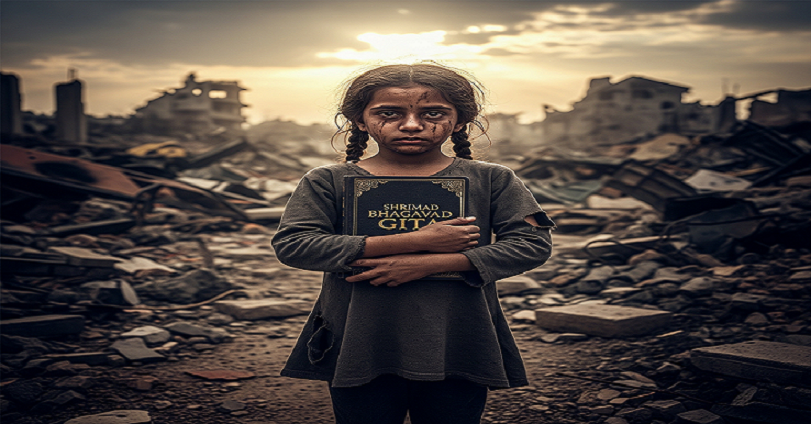
The philosophy of karma—the principle that every action carries consequences—is deeply embedded in Indian tradition. It transcends faiths and ideologies, reminding both individuals and societies that deeds, whether good or evil, leave a lasting imprint on the course of destiny.
As the world watches the humanitarian crisis unfold in Gaza, many are drawn to this ancient principle. The devastation is undeniable: displaced families, destroyed homes, and civilian casualties on a massive scale. Compassion demands we care for the innocent. But with compassion comes reflection: how did we get here? What series of choices, ideologies, and actions brought us to this tragic moment?
The events of October 7, 2023, when Hamas militants launched a brutal attack on Israeli civilians, killing over 1,200 people—including women, children, and the elderly—shocked the world BBC, 2023. Disturbingly, in some circles, these actions were not only excused but celebrated. Crowds were seen cheering, praising the violence as religious duty—revealing a deep-rooted acceptance of extremism among certain factions The Guardian, 2023.
What followed was predictable, though no less tragic: a severe military response from Israel. And while militants may have sparked the conflict, it is often the civilians—many of whom had no hand in the violence—who suffer its full wrath.
This isn’t karma as vengeance. It’s karma as consequence. When societies normalize violence, glorify terror, or stay silent in the face of injustice, they set in motion forces they may not be able to stop. In Gaza, those celebrating past acts of violence now find themselves in a world where empathy is thinning, and support is hesitant.
Closer to home, the Indian subcontinent offers its own powerful examples of karma in action. The exodus of Kashmiri Pandits in 1990, following threats and targeted killings by Islamist groups, is well documented India Today, 1990. Families were uprooted, lives lost, and gruesome crimes—such as the brutal rape and murder of Girija Tickoo—became etched into history.
During that time, many celebrated or ignored the suffering of others. In some areas, even laughter and joy accompanied the forced displacement. Similarly, during the Partition of India, over 90% of Muslim voters in key provinces supported the creation of Pakistan through the Muslim League Stanford, 2012. These democratic choices, made in a moment of communal division, changed the destiny of millions forever.
Karma doesn’t discriminate. It affects individuals and collectives alike. It asks not only what was done—but what was tolerated, celebrated, or ignored. That’s why it’s not simply a mystical belief—it’s a societal law of cause and effect.
But karma also provides a path forward. Just as past wrongs can bring suffering, present choices can bring healing. A society that acknowledges its history, condemns violence regardless of faith or politics, and invests in compassion and justice, can break the cycle.
Let us be clear: no child deserves war. No civilian deserves violence. But karma reminds us: if hatred is seeded long enough, it may one day return—often at the cost of the innocent.
Let Gaza, Kashmir, and Partition serve not as fuel for more division, but as mirrors. Mirrors in which we must ask: what did we do? What did we allow? And what must we now change?
Peace does not arise from ideology. It grows from truth, humility, and action. And karma, in its quiet certainty, ensures that nothing done is ever lost.
References
-
BBC News. “Israel-Gaza: Hamas Attack – What We Know.” BBC, October 2023.
-
Human Rights Watch. “Israel/Palestine: Apparent War Crimes by Hamas.” HRW, October 2023.
-
The Guardian. “Reactions in Gaza to the Hamas Attack.” The Guardian, October 2023.
-
Times of Israel. “Hamas Publishes Graphic Videos for Psychological Warfare.” Times of Israel, 2023.
-
India Today. “Kashmir Hindus Forced to Exodus by Muslim Extremists.” India Today Archives, February 1990.
-
BBC News. “Remembering the Kashmiri Pandit Exodus.” BBC, January 2020.
-
Stanford University. “Voting Patterns in British India: The Muslim League’s Support.” Stanford Political Science.
-
Singh, Jaswant. Jinnah: India–Partition–Independence. Rupa Publications, 2009.
-
Chinmayananda, Swami. The Holy Geeta. Central Chinmaya Mission Trust, 1980.
-
Bhagavad Gita, Trans. A.C. Bhaktivedanta Swami Prabhupada. The Bhaktivedanta Book Trust, 1972.
-
Sharma, Swati Goel. “Girija Tickoo and the Kashmiri Pandit Atrocities.” OpIndia, 2022.
-
Coward, Harold, ed. Hindu Ethics: Purity, Abortion, and Euthanasia. Oxford University Press, 1989.