
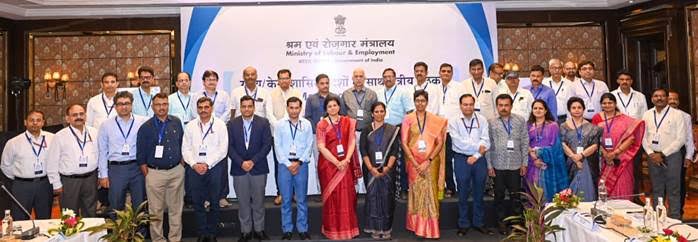

Shri Ganesh Ram SinghKhuntia, Minister of State (Independent Charge) for Labour and Employees’ State Insurance, Government of Odisha, inaugurated the conference. Union Secretary, Ministry of Labour & Employment, Ms. Vandana Gurnani, along with senior officials from Odisha, Bihar, Jharkhand, Chhattisgarh and Andaman and Nicobar Islands, attended the event.
Representatives from the Employees’ State Insurance Corporation (ESIC), Employees’ Provident Fund Organisation (EPFO), Central Labour Commissioners and the VV Giri National Labour Institute (VVGNLI) were also present.
Focus on Labour Codes Implementation
Addressing the gathering, Shri SinghKhuntia said India is at a significant juncture as the four Labour Codes move into the implementation phase. He described the Codes as transformative reforms that modernise labour governance while ensuring worker protection.
He highlighted Odisha’s preparatory steps, including publication of draft rules and welfare initiatives for construction workers, unorganised labourers and migrant workers. These measures, he said, aim to promote employment opportunities and social justice.
The conference agenda included detailed deliberations on finalising Rules under the Codes, identifying gaps and ensuring timely statutory notifications.
Streamlining Laws, Strengthening Protections
Union Secretary Ms. Vandana Gurnani described the Labour Codes as historic reforms consolidating multiple central labour laws into four streamlined Codes. She noted that the reforms aim to balance ease of doing business with strengthened worker safeguards.
Key features discussed included mandatory appointment letters specifying service conditions, prohibition of discrimination and exploitation, universalisation of minimum wages beyond scheduled employments, and universal social security coverage.
The introduction of a statutory floor wage by the Central Government below which States cannot fix minimum wages was also highlighted as a significant step towards uniform wage protection.
Digital Integration and Capacity Building
Participants reviewed IT-enabled systems such as single registration, single licence and single return mechanisms designed to reduce compliance burdens. States and UTs were encouraged to integrate their platforms with the Central digital framework to ensure seamless implementation.
The VV Giri National Labour Institute is conducting capacity-building programmes under the Labour Codes, and States were urged to nominate master trainers to expand knowledge dissemination at the grassroots level.
Discussions also covered the Pradhan Mantri Viksit Bharat Rozgar Yojana (PMVBRY), expansion of ESIC coverage and strengthening medical infrastructure through convergence with State health facilities and the Ayushman Bharat – PMJAY scheme.
Strengthening Centre–State Coordination
The conference provided a platform for collaborative policy dialogue between the Centre and States. Officials discussed the establishment of Boards, Funds and institutional mechanisms envisaged under the Codes.
Emphasis was placed on expediting rule finalisation, upgrading IT systems and enhancing awareness among field-level officers and stakeholders about the objectives and roadmap of the Labour Codes.
As India advances towards comprehensive labour reforms, the Bhubaneswar regional conference underscored the importance of cooperative federalism in ensuring that the benefits of these reforms reach workers and industries across the country.