
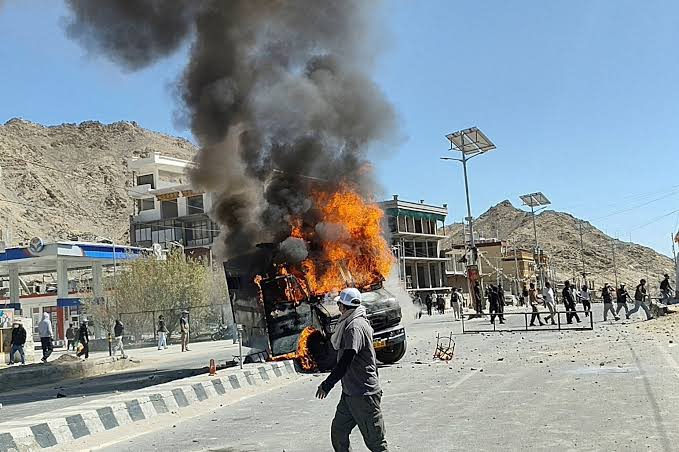


What began as peaceful demonstrations quickly spiraled out of control when protesters clashed with security forces in Leh. Witnesses reported that a local office of the ruling Bharatiya Janata Party (BJP) and a police vehicle were set ablaze. According to officials, more than 30 security personnel sustained injuries during the confrontation.
Police fired tear gas and live rounds to disperse the crowd. Four protesters, critically injured during the firing, later succumbed to their wounds. The Ministry of Home Affairs described the police action as self-defense, stating that officers had no option but to open fire when attacked.
Government Blames Sonam Wangchuk
The federal government pointed fingers at activist Sonam Wangchuk, accusing him of inciting violence through provocative speeches referencing movements like the Arab Spring. Wangchuk, who had been on a hunger strike since 12 September, strongly denied the allegations, insisting that the protests had always been peaceful.
“Violence only damages our cause,” Wangchuk said after calling off his fast on Wednesday night. He argued that mounting frustration among unemployed youth and the federal government’s delayed response had fueled the anger, not his leadership.
Communities United in Demands
Ladakh, home to around 300,000 people, was carved out of Jammu and Kashmir in 2019 and placed under direct federal rule. While the Buddhist-majority Leh district had historically sought separate recognition, and the Muslim-majority Kargil wanted closer ties with Kashmir, both communities have now united to demand statehood and constitutional safeguards for land, jobs, and culture.
“The government’s repeated delays in dialogue have pushed the youth to desperation,” said Chhering Dorje Lakrook, head of the influential Ladakh Buddhist Association. He noted that unemployment remains a pressing concern and has amplified the call for autonomy.
Dialogue Process and Tensions
The federal government maintains that dialogue with Ladakhi leaders has been ongoing since 2023, claiming that progress has been made. However, protest leaders argue that promises remain unfulfilled, and meaningful autonomy has not been granted.
Ladakh’s Lieutenant Governor, Kavinder Gupta, described the violence as the result of “deliberate attempts to incite people,” drawing comparisons with protests in Nepal and Bangladesh. He confirmed that an investigation into the unrest has been launched.
New rounds of talks between activists and officials are scheduled for later this week, with a federal committee set to meet Ladakhi leaders on 6 October.
Strategic Importance of Ladakh
Ladakh remains a sensitive border region, sharing boundaries with both China and Pakistan. The area saw deadly clashes between Indian and Chinese troops in the Galwan Valley in 2020, underscoring its geopolitical volatility. Many locals fear that the removal of special protections has made the region vulnerable to outside economic interests and diluted local governance.
The outcome of ongoing talks may determine whether the current unrest subsides or fuels a larger movement demanding full statehood for Ladakh.