
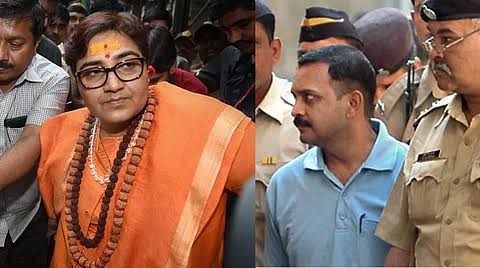
After nearly 17 years of trial, a Mumbai court acquits all 7 accused in the 2008 Malegaon blast case, citing lack of evidence.
A Landmark Verdict in a High-Profile Case
On July 31, 2025, the special NIA Court in Mumbai delivered a historic verdict. It acquitted all seven accused in the 2008 Malegaon bomb blast case. Among those cleared were BJP MP Pragya Thakur and Army officer Lt. Col. Prasad Purohit.
The judgment ends a legal battle that lasted over a decade and a half. The court ruled that the prosecution failed to prove any direct involvement of the accused in the tragic incident.


On September 29, 2008, a motorcycle rigged with explosives detonated near a mosque in Malegaon, Maharashtra. The blast killed six people and injured over 100 others. The incident sent shockwaves across the nation.
Initially, the Maharashtra Anti-Terrorism Squad (ATS) investigated the case. In 2009, they filed a chargesheet against 12 accused, including Pragya Thakur and Col. Purohit. The charges included conspiracy, terrorism, and murder under the stringent Unlawful Activities (Prevention) Act (UAPA) and the Explosives Substances Act.
Controversial Investigations: ATS vs NIA
In 2011, the National Investigation Agency (NIA) took over the probe. Their findings contradicted the ATS report. While the ATS alleged the blast was a revenge plot against Muslims by a right-wing group, the NIA said there was no solid proof.
The NIA eventually dropped all charges against Pragya Thakur in its 2016 supplementary chargesheet. It even accused the ATS of coercing witnesses. However, the special court refused to discharge her back then, citing incriminating material from the original ATS probe.
Key Highlights from the Court Judgment
- The prosecution failed to prove the bike used in the blast belonged to Pragya Thakur.
- No evidence of RDX being stored at Col. Purohit’s residence was found.
- No credible proof that Abhinav Bharat — an organization allegedly founded by the accused — funded any terror activities.
- The court ruled that samples were contaminated and sketches were not maintained properly.
Special Judge A.K. Lahoti noted that Pragya Thakur had turned into a Sadhvi two years before the blast and that there was no cogent material against her or the co-accused.
Political Repercussions and Public Reactions
The Malegaon case has been politically sensitive since its beginning. Many accused were linked to right-wing ideology, sparking fierce political debates. The abrupt removal of Public Prosecutor Rohini Salian in 2015, after she claimed she was told to “go soft” on accused by NIA, added to the controversy.
Following the verdict, political leaders and social activists expressed mixed reactions. Supporters of the accused hailed the verdict as justice delayed but finally delivered. Others criticized the slow judicial process and questioned the NIA’s credibility.
Justice or Judicial Failure?
Seventeen years is a long time to wait for justice — both for the victims and the accused. While the court acquitted all accused due to lack of evidence, the blast victims’ families still seek closure.
This case highlights the urgent need to reform investigative agencies and improve judicial efficiency in India’s anti-terrorism trials. Evidence handling, witness protection, and transparency must be strengthened to prevent such delays and ensure justice for all.
Conclusion: A Turning Point for Indian Terror Trials?
The Malegaon blast case verdict will go down as a turning point in India’s legal and political history. It raises serious questions about the handling of terror cases and the balance between justice and political pressure.
As India moves forward, it must learn from such high-profile cases. The justice system must be fast, fair, and free from interference — for the sake of democracy and truth.