
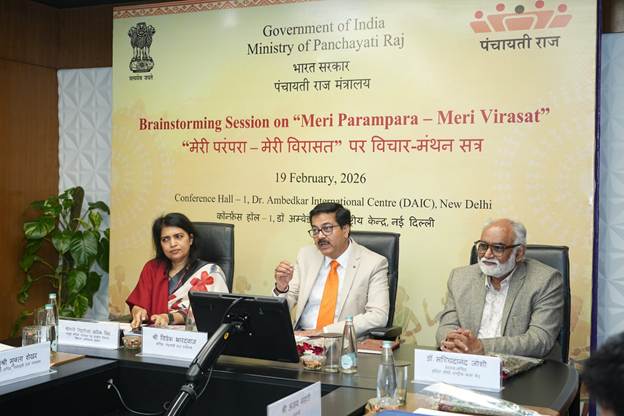
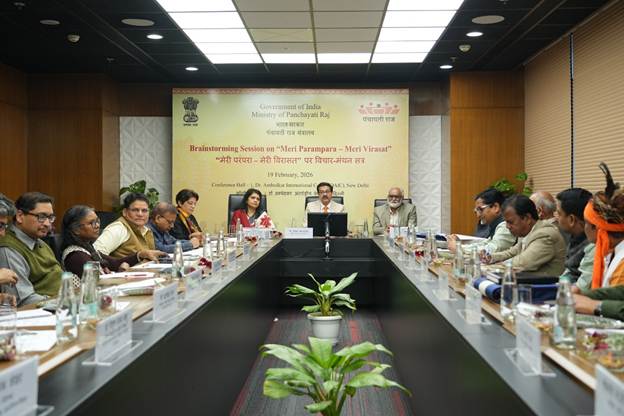
Shri Vivek Bharadwaj, Secretary, Ministry of Panchayati Raj, highlighted that the identity of tribal communities is deeply rooted in their traditions and customs. He stressed that the initiative’s community-led approach ensures authenticity, as heritage documented by the communities themselves carries enduring value. Collective efforts guided by shared purpose, he noted, are key to sustaining tribal cultural practices.
Smt. Niharika Barik Singh, Principal Secretary, Panchayat and Rural Development Department, Chhattisgarh, shared the State’s framework for implementation, emphasizing Chhattisgarh’s rich tribal heritage as a strong foundation for the initiative. Dr. Sachchidanand Joshi, Member Secretary, IGNCA, noted that digitising tribal traditions will preserve living heritage, connect youth with their roots, and strengthen community ownership of cultural narratives.
Leveraging Technology for Cultural Documentation
The session also presented the upgraded Mera Gaon Meri Dharohar (MGMD) portal under the National Mission on Cultural Mapping, a collaborative initiative by the Ministry of Culture and the Ministry of Panchayati Raj. The Gram Sabha serves as the primary platform for village-level cultural documentation, enabling structured meetings across Panchayats for systematic data collection and validation.
The brainstorming focused on two core themes: documentation and digital preservation of tribal heritage in Scheduled Areas of Chhattisgarh, and finalizing the implementation framework for the project. Discussions were organized around ten thematic areas including knowledge traditions, visual and material arts, performing arts, rituals, histories, literature, built spaces, natural environment, institutions, and people.
Background and Expansion
“Meri Parampara–Meri Virasat” is conceptualized and supported by the Ministry of Panchayati Raj, executed in collaboration with State Governments and other stakeholders. The initiative seeks to document and digitally preserve tribal cultural heritage, including folk songs, festivals, worship practices, oral traditions, art forms, and customary governance systems. Chhattisgarh is the second state to adopt the initiative, after Jharkhand launched it in January 2025 under the theme “Hamari Parampara Hamari Virasat”.
With 42 recognized Scheduled Tribes, including Particularly Vulnerable Tribal Groups (PVTGs), Chhattisgarh offers a diverse cultural canvas for the project. The initiative aims to ensure that traditional knowledge and heritage are preserved for future generations while empowering communities to maintain cultural continuity within the framework of modern governance.