
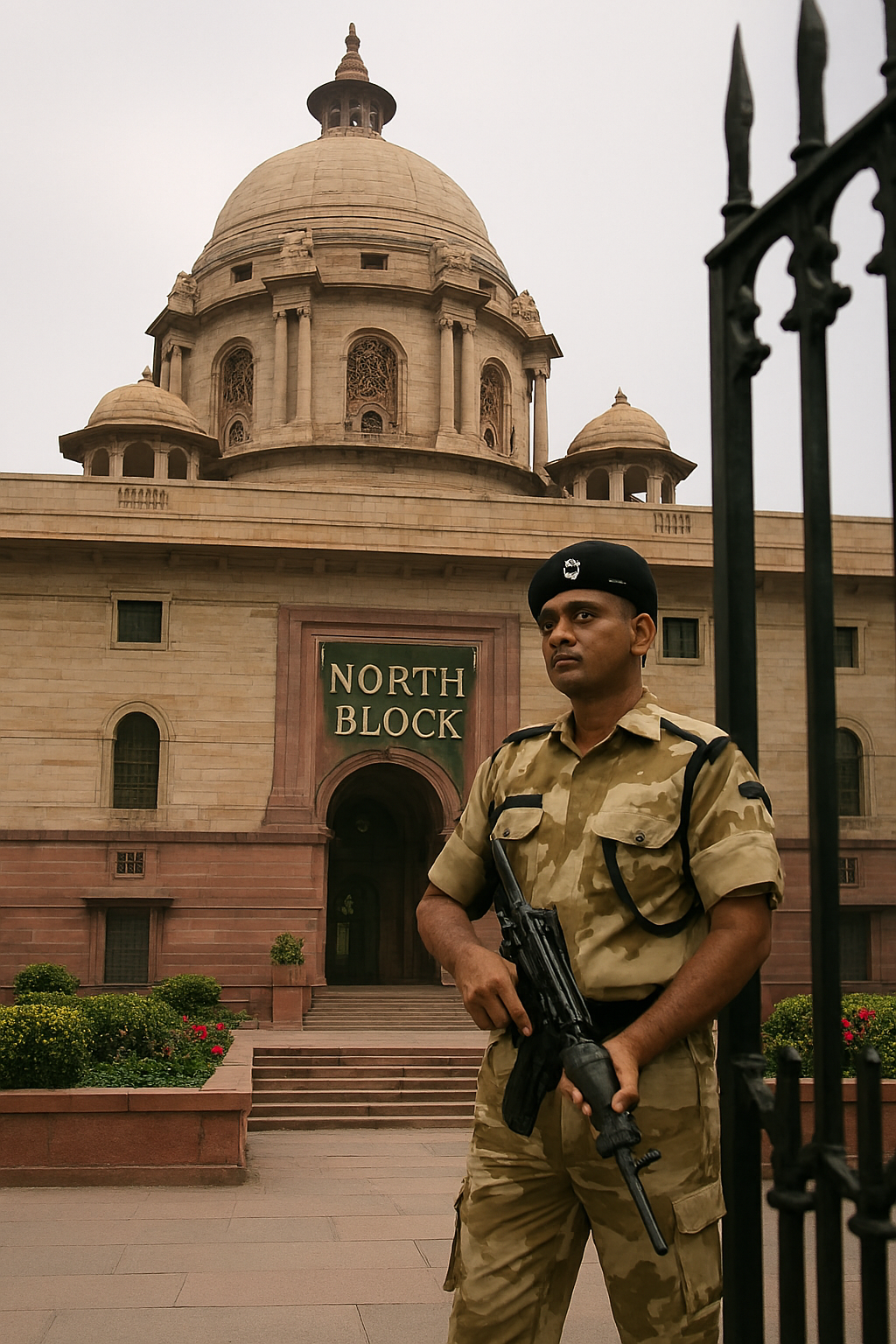
A Colonial Chapter Comes to a Close
In a powerful symbolic gesture, the Ministry of Home Affairs (MHA) has vacated its historic office at North Block, bringing an end to nearly a century of colonial-era governance from the iconic structure.
This move marks the first full transition by a central government ministry to the newly constructed Common Central Secretariat (CCS) as part of the Central Vista Redevelopment Project.
North Block: A Legacy of Empire
Designed by British architect Herbert Baker in the early 1900s, North Block—along with its twin South Block—stood atop Raisina Hill as a symbol of British imperial power.
Its commanding position near the Viceroy’s House (now Rashtrapati Bhavan) was no accident. Baker wanted the buildings to project awe and authority, reflecting the dominance of the Indian Civil Service.
Historian accounts like *Indian Summer: Lutyens, Baker and Imperial India* describe how these buildings were meant to inspire “reverence” and separate rulers from the ruled.


According to officials, the MHA’s exit aligns with Prime Minister Narendra Modi’s ‘Paanch Pran’—five vows declared from the Red Fort in 2022 to shape a new India.
One of those vows was to “shed the colonial mindset”. The decision to relocate key ministries from imperial buildings to modern, indigenously designed spaces stems from that national vision.
A New Home in the Heart of New Delhi
The MHA has now shifted to a state-of-the-art, 347-room facility in CCS-3 along Janpath Road. This is one of ten new blocks forming the Common Central Secretariat, designed to bring all ministries under one roof.
This consolidation is not just symbolic. Government estimates suggest it could save over ₹1,000 crore annually by eliminating rented spaces and improving administrative efficiency.
The End of Aloofness: ‘Returning to the People’
Senior officials describe the move as a step away from elitism. “We are vacating exalted offices created to detach the rulers from the commoners. We’re returning to the people,” said a source involved in the relocation.
The shift reflects a broader intent to make government infrastructure more open, accessible, and people-centric.
What’s Next for North and South Blocks?
Once fully vacated, the North and South Blocks will be repurposed into the Yuge Yugeen Bharat National Museum. This cultural project will span over 1.55 lakh square metres and celebrate India’s civilizational journey.
In 2024, the Ministry of Culture signed a landmark agreement with France Museums Développement (FMD) to assist in developing this mega museum, further enhancing India’s cultural diplomacy.
Upcoming Shifts: PMO, Finance, and More
Following the MHA’s lead, other top ministries are also preparing to relocate, including the Prime Minister’s Office (PMO), and the Ministries of Finance, Defence, and External Affairs.
This staggered shift will ensure continuity in governance while completing the transformation envisioned under Central Vista.


Caption: The newly inaugurated CCS complex along Janpath Road. Photo Credit: Central Vista Project Archives
Public Reactions: Heritage vs. Modernity
The public reaction is mixed. Some citizens and conservationists feel nostalgia for the buildings that witnessed India’s transition from colony to republic.
Others support the change, viewing it as a necessary step in India’s journey towards decolonization and modernization.
Conclusion: Beyond Bricks and Mortar
India’s governance is entering a new phase—one that seeks to erase colonial shadows and build with a vision rooted in its own identity.
The MHA’s departure from North Block is more than a change in address. It’s a quiet but profound assertion of India’s evolving sense of self.