
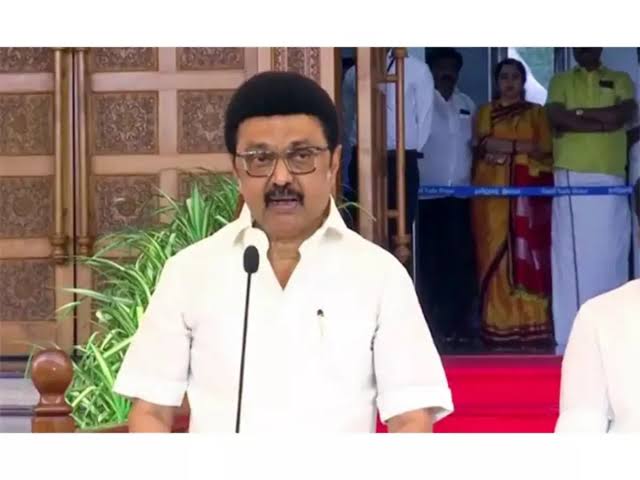
MK Stalin Unveils TN’s Education Policy, Counters NEP
In a bold step against the Centre’s National Education Policy (NEP), Tamil Nadu Chief Minister MK Stalin launched the State Education Policy (SEP) on August 8, 2025.
Positioned as a progressive alternative, the policy emphasizes science, artificial intelligence (AI), English proficiency, and equal access to education. It is Tamil Nadu’s firm response to what the state calls the “regressive and centralised” model of the NEP.
A Clear Message to the Centre
The timing of this launch is critical. The Modi government’s NEP has drawn sharp criticism in southern states, especially Tamil Nadu. The DMK-led state government sees the NEP as an infringement on state rights and cultural autonomy.
Speaking at the event, MK Stalin said, “This policy is rooted in the soil of Tamil Nadu. It respects our identity, language, and constitutional rights.”


The SEP was drafted by a high-level committee chaired by Justice D. Murugesan, a retired High Court judge. It was submitted in 2024, and after a detailed review, launched officially today.
Key Features:
- No entrance exams for arts and science colleges
- Admissions based on Class 9 and 10 marks
- Focus on science, AI, and English language skills
- Strong emphasis on equitable access to quality education
- Promotion of Tamil language and local history
In contrast to the NEP, which promotes a common entrance test for higher education, the SEP removes this barrier. This move is seen as a measure to level the playing field for rural and underprivileged students.
Rejecting the Three-Language Formula
One of the most controversial aspects of the NEP is its three-language formula, often seen as an attempt to impose Hindi. Tamil Nadu’s SEP firmly rejects this idea.
The policy states that students will continue with a two-language system—Tamil and English. This protects the linguistic identity of the state while ensuring global competitiveness through English proficiency.
Funding Crisis Amid Policy War
In a striking development, the Centre has withheld ₹2,152 crore meant for Tamil Nadu under the Samagra Shiksha Abhiyan, allegedly due to its refusal to adopt the NEP.
CM Stalin addressed this directly: “Education is a concurrent subject. Punishing states for exercising their rights is unacceptable in a federal democracy.”
AI and Future-Readiness
In a forward-looking vision, the SEP introduces curriculum changes that include artificial intelligence, machine learning, and coding from the secondary level.
This positions Tamil Nadu as one of the first Indian states to integrate emerging technologies into mainstream public education.
English for Empowerment
The policy also promotes strong English-language instruction—not at the cost of Tamil, but to empower students for global opportunities.
Educationists have welcomed this move. Dr. Sumathi R., an academic from Madurai, said: “This is a practical policy that considers both local relevance and global readiness.”
NEP vs SEP: A Policy Clash
While the Centre claims the NEP fosters flexibility, critics argue it centralizes control and favors urban, upper-class demographics.
The SEP, in contrast, aims for social justice, inclusivity, and decentralization. It aligns with Tamil Nadu’s long-standing Dravidian model of development, prioritizing backward classes and public welfare.
National Implications
The launch of Tamil Nadu’s SEP may inspire similar moves in other states. Kerala and West Bengal have also voiced concerns about the NEP. With elections approaching, education is becoming a key battleground.
The Union government has yet to respond officially to the SEP’s release, but political observers expect pushback.
Conclusion
The State Education Policy is more than a document. It’s a declaration of Tamil Nadu’s autonomy, values, and vision for its children.
As MK Stalin put it, “This is education that builds both knowledge and dignity.”
Whether the Centre accepts it or not, Tamil Nadu has drawn a bold line—and crossed it.