
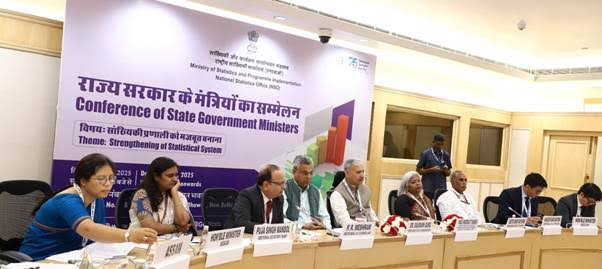
New Delhi, July 22, 2025: The Ministry of Statistics and Programme Implementation (MoSPI) successfully hosted a landmark conference on Strengthening of Statistical Systems on April 5, 2025. Held in New Delhi, the event brought together Ministers and senior officials from State Governments and Union Territories (UTs) to discuss critical improvements in India’s data ecosystem.
Why the Conference Was Important
The key objective of the conference was to highlight the need for producing relevant, accurate, and timely statistics at both the national and sub-national levels. This is especially important in a growing economy where policy decisions must be based on credible socio-economic indicators.
Accurate statistics are essential for shaping public policy, allocating resources, and evaluating impact. Without consistent and quality data, even well-intentioned programs may fall short of their goals.


One of the most significant outcomes was the emphasis on collaboration between MoSPI and State Governments. The ministry reaffirmed its commitment to regularly organizing training programs, workshops, and technical conferences with the States and UTs.
These sessions are designed to build capacity and improve data collection at the sub-state level. MoSPI representatives often serve as members of state-level committees to guide the development of standardized statistical indicators.
District-Level Estimates Now a Priority
A major advancement announced during the conference was the inclusion of district-level estimates in the National Sample Survey (NSS). This new approach adopts ‘district’ as the basic unit in the sampling design, offering granular insights.
States can now participate in these surveys to generate annual district-wise estimates for major indicators. These will help in targeted policy formulation, improving the accuracy of welfare programs across different regions.
Launch of Key Digital Tools
The Union Minister, Rao Inderjit Singh, released MoSPI’s annual publication, “Women and Men in India 2024: Selected Indicators and Data.” This comprehensive report offers insights into gender-based statistics and serves as a critical tool for inclusive policy planning.
The conference also saw the launch of the National Statistical Systems Training Academy (NSSTA) website. This digital platform will streamline training efforts and make statistical learning resources more accessible to State and UT officers.
Revamped Micro-data Portal Goes Live
Another highlight was the unveiling of the upgraded Micro-data Portal of MoSPI. Currently hosting data from over 175 socio-economic surveys, the portal enhances public access to micro-level datasets. It also ensures better transparency and encourages evidence-based research.
Moreover, a new semantic search feature for the National Industrial Classification (NIC) Code was showcased. Developed during a recent Hackathon at IIT Gandhinagar, this tool makes it easier to classify businesses and sectors using advanced AI search mechanisms.
Collaboration as the Key to Progress
Throughout the conference, the recurring message was clear: State and Central collaboration is crucial. Statistical systems must be uniform, integrated, and scalable. Only then can India achieve data-driven governance and inclusive development.
The Union Minister stressed that reliable and disaggregated data will enable real-time monitoring of schemes like PMAY, MGNREGA, Ayushman Bharat, and National Education Policy implementation at the ground level.
Government’s Commitment to Data Reform
India’s emphasis on statistical modernization is not new. MoSPI has been working toward improving survey design, reducing time lags in data release, and aligning data standards with international frameworks like the SDGs (Sustainable Development Goals).
This conference further strengthens that direction. It brings States into the fold, empowering them with tools and training to meet national benchmarks in data generation and management.
Looking Forward: Building a Data-Strong India
With the integration of digital tools, granular survey models, and inter-governmental collaboration, India is taking a giant step toward becoming a data-empowered economy.
The success of this conference reflects MoSPI’s vision to transform India’s statistical system into one that is modern, responsive, and citizen-centric.
By improving the way we collect, analyze, and share data, India will not only enhance governance but also create a stronger foundation for inclusive and sustainable growth.