
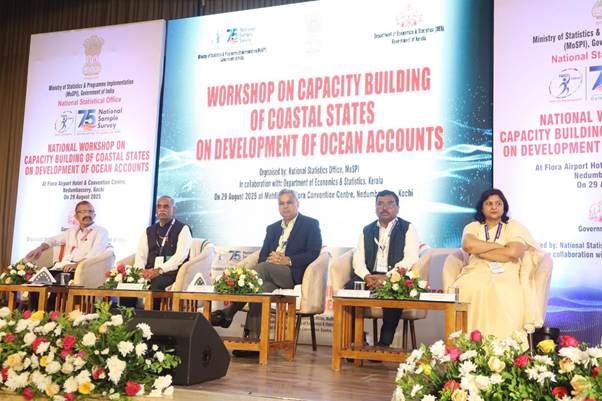
Focus on Integrating Ocean Ecosystems into National Accounts
In his inaugural address, Dr. Saurabh Garg, Secretary, MoSPI, stressed the importance of incorporating ocean ecosystem data into India’s statistical systems, especially in the context of the upcoming UN System of National Accounts (SNA-2025). He underlined that natural assets such as oceans, forests, and water bodies must be accounted for in GDP estimates to reflect their economic and ecological value. Such integration, he said, would improve transparency, promote equitable distribution of ecosystem benefits, and support data-driven policymaking for climate adaptation and disaster risk management.
Dr. Garg highlighted India’s role in shaping global blue economy principles during its G20 presidency in 2023, particularly through the Chennai High-Level Principles for Sustainable Blue Economy. He also emphasized the relevance of Sustainable Development Goal 14: Life Below Water, which seeks to conserve marine resources through sustainable management, biodiversity protection, and pollution control.
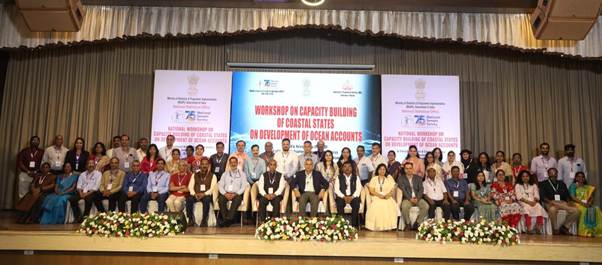

The workshop featured technical sessions with contributions from leading institutions such as the Central Marine Fisheries Research Institute (CMFRI), Indian National Centre for Ocean Information Services (INCOIS), National Remote Sensing Centre (NRSC), National Centre for Coastal Research (NCCR), and Centre for Marine Living Resources & Ecology (CMLRE).
Ms. Anita Baghel from MoSPI introduced the System of Environmental-Economic Accounting (SEEA) and outlined India’s progress on ocean accounting. Dr. Aswathy N from CMFRI highlighted how fisheries data can be leveraged to build robust ocean accounts, while Dr. Venkat Shesu Reddem of INCOIS called for standardised frameworks for assessing ocean conditions.
Dr. P.V. Nagamani of NRSC showcased how satellite remote sensing and geospatial technologies can serve as vital tools for ocean ecosystem monitoring. Dr. U.S. Panda from NCCR shared preliminary findings of Ocean Accounts for Tamil Nadu, estimating that marine natural assets contribute nearly 1% of the state’s GSDP. Dr. Smitha B.R of CMLRE stressed that tracking marine ecosystem health is essential for assessing the impacts of climate change on resource potential and resilience.
Experts from the Indian Maritime University also underlined the role of ocean energy as a critical sector within India’s blue economy strategy, urging stronger research and innovation in sustainable ocean development.
Kerala’s Contribution and National Roadmap
Welcoming participants, Shri Subash Chandra Malik, Additional Director General at MoSPI, noted the workshop’s significance in strengthening coastal states’ capacities. He commended Kerala’s Directorate of Economics and Statistics for its expertise and encouraged states to collaborate in building comprehensive ocean accounts.
In the vote of thanks, G.S. Rajath, Director, DES Kerala, acknowledged the collaborative efforts of central ministries, research institutions, and state representatives. He emphasised that effective ocean accounting requires translating discussions into actionable plans at the state level.
The workshop concluded with a roadmap to enhance institutional coordination, develop state-level capacities, and create policy-relevant data frameworks. MoSPI reaffirmed its commitment to work closely with states, scientific bodies, and international partners to build a national framework for Ocean Accounts, aligning with India’s goal of sustainable ocean governance under the vision of Viksit Bharat@2047.