
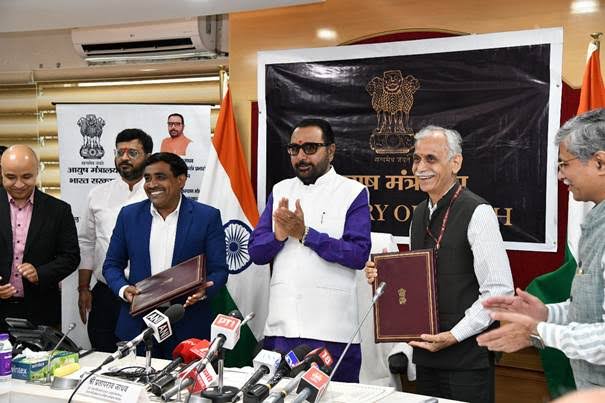
In a powerful move to preserve India’s medicinal plant heritage, the National Medicinal Plants Board (NMPB), under the Ministry of Ayush, signed two crucial Memoranda of Understanding (MoUs) in the presence of Union Minister Shri Prataprao Jadhav at Nirman Bhawan, New Delhi.
These MoUs aim to conserve rare and threatened medicinal plants and increase public awareness about their use and value.
Preserving Rare Medicinal Plants Through Technology
The first MoU was signed between NMPB and Pune-based IshVed-Bioplants Venture. It focuses on the conservation of rare, endangered, and threatened (RET) medicinal plants.
This collaboration will use tissue culture technology to develop sustainable cultivation and preservation protocols. The aim is to make RET plants more accessible to the Ayush industry and researchers.
By applying scientific methods, this partnership will help ensure the availability of authentic and high-quality germplasm to stakeholders and Ayush practitioners nationwide.
Union Minister Shri Jadhav emphasized, “This is a step towards fulfilling Prime Minister Narendra Modi’s vision of a healthier, self-reliant India by 2047. Conservation and modern science must go hand in hand.”


The second MoU was a tripartite agreement among NMPB, All India Institute of Ayurveda (AIIA), and AIIMS New Delhi. The collaboration will lead to the creation of a National Medicinal Plants Garden on the AIIMS campus.
This herbal garden will serve as a live, educational space for patients, visitors, and students. It will offer a hands-on introduction to India’s medicinal flora and promote public awareness of Ayurvedic plants.


Caption: Proposed site for the Medicinal Plants Garden at AIIMS Delhi, aimed at public awareness.
Alt text: Medicinal Plants Garden at AIIMS Delhi.
Description: Conceptual layout of the herbal garden to be established under the NMPB-AIIA-AIIMS MoU to educate the public on herbal medicine.
The garden will showcase a wide range of plants used in Ayurvedic medicine, complete with descriptions and benefits. It will also highlight the ecological importance of conservation.
Leadership and Vision for the Future
The event was attended by key dignitaries, including Shri Vaidya Rajesh Kotecha (Secretary, Ministry of Ayush), Shri M. Srinivas (Director, AIIMS), and Smt. Ankita Mishra Bundela (Joint Secretary, Ministry of Health and Family Welfare).
They reaffirmed their commitment to fostering synergy between traditional Indian knowledge and modern scientific research to build an ecosystem for medicinal plant sustainability.
Both MoUs align with the government’s broader agenda of evidence-based conservation, healthcare integration, and rural development through the Ayush medicinal plant sector.
Why This Matters
India is home to over 6,500 species of medicinal plants. Many of these are under threat due to deforestation, overharvesting, and habitat loss.
The MoUs provide a roadmap for using scientific tools like tissue culture to regenerate and preserve these plants. They also open the door to institutional collaboration and public outreach.
Ultimately, these efforts will help secure raw material supply chains for the Ayush industry, promote community participation, and empower future researchers and students.
Looking Ahead
As India marches toward its 2047 vision of “Viksit Bharat”, these collaborations show how tradition and innovation can work together.
Through awareness gardens and scientific preservation methods, the Ministry of Ayush is building a bridge between heritage and future readiness.
By bringing RET medicinal plants to the forefront, the initiative not only saves natural resources but also nurtures livelihoods and health for generations to come.