 Mission Shakti: An umbrella for safety and empowerment
Launched as an integrated women’s empowerment programme, Mission Shakti operates through two verticals: Sambal for safety and security, and Samarthya for empowerment. Sambal includes One Stop Centres, Women Helplines, Beti Bachao Beti Padhao (BBBP) and Nari Adalat. Samarthya supports infrastructure such as Shakti Sadan and Sakhi Niwas, along with welfare measures including Pradhan Mantri Matru Vandana Yojana (PMMVY) and SANKALP: Hub for Empowerment of Women.
Officials say the Sambal vertical reinforces immediate protection and community action, while Samarthya focuses on long-term capacity building and economic independence.
Education and health: from foundational learning to higher ambition
Education schemes such as Samagra Shiksha back schooling from pre-school to Class XII and align with the National Education Policy 2020 to close gender gaps. Kasturba Gandhi Balika Vidyalaya (KGBV) provides residential schooling to girls aged 10–18 from disadvantaged groups, enabling continued study through adolescence.
Nutrition and maternal care receive support through PMMVY, which gives cash incentives to pregnant women and new mothers to improve health outcomes. The Government also notes sanitation gains: under Swachh Bharat Mission, more than 11.99 crore toilets have been built improving school attendance and safety for girls in rural areas.
Financial security and targeted savings
Long-term financial tools such as the Sukanya Samriddhi Yojana (SSY) offer a tax-preferred savings route for girls, while direct cash incentives under PMMVY aim to reduce early childbearing and support infant care.
These instruments are designed to ease household financial burdens and make investment in girls’ education and health more feasible for economically vulnerable families.
Skills, livelihoods and entrepreneurship
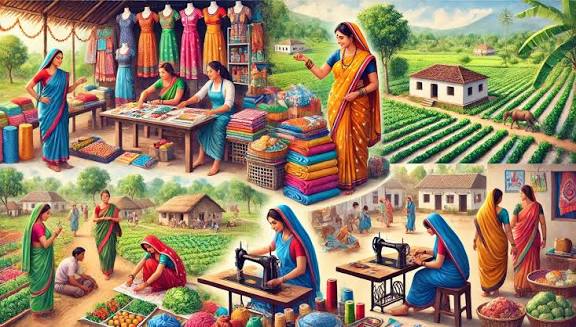
The Government promotes economic independence for girls through skill development initiatives under Skill India. Pradhan Mantri Kaushal Kendras and PMKVY programmes deliver vocational training, with PMKVY 4.0 giving special focus to projects where women are primary beneficiaries.
Livelihood missions DAY-NRLM in rural areas and NULM in urban centres support self-help groups and micro-enterprises. Schemes such as Stand-Up India, Start-Up India and PM SVANidhi extend credit and enterprise support, increasing women’s participation in the formal economy.
Adolescents, STEM and inclusion
The Scheme for Adolescent Girls (now part of Mission Saksham Anganwadi and Poshan 2.0) targets girls aged 14–18 in aspirational and North Eastern districts. Vigyan Jyoti encourages meritorious girls from Class IX to XII into STEM careers through counselling, lab visits and mentoring tackling gender bias in science and technology fields.
Such targeted programmes aim to expand career horizons and create pathways into high-growth sectors for young women.
Why the approach matters
Officials told Parliament that the multi-pronged model combines immediate protection with long-term opportunity: safety nets reduce vulnerability, education and health measures improve human capital, and skills plus credit support create economic agency.
By coordinating schemes Beti Bachao Beti Padhao, PMMVY, SSY, Samagra Shiksha, PMKVY and livelihood missions the Government says it seeks a holistic uplift in girls’ welfare and prospects.