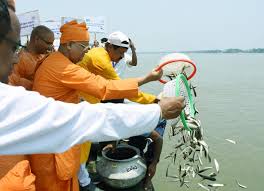
New Delhi, February 26: A decade of scientific river ranching under the Government of India’s Namami Gange Programme has significantly strengthened indigenous fish stocks in the River Ganga and its tributaries. Between 2017 and 2025, 205.5 lakh indigenous fish seeds were released through 169 targeted ranching interventions, marking one of the largest freshwater restoration efforts in the country.
 Science-Led Restoration of Riverine Biodiversity
The large-scale intervention has been led by the ICAR–Central Inland Fisheries Research Institute (ICAR-CIFRI), which implemented evidence-based strategies to revive depleted native fish populations. The programme focused on conserving indigenous species, maintaining genetic integrity and promoting sustainable riverine fisheries.
Fish populations in the Ganga have faced decades of stress due to pollution, habitat degradation, altered flow regimes and overfishing. Scientific ranching was designed not merely to increase numbers but to rebuild ecological balance.
Scale and Geographic Focus
The 169 ranching programmes were conducted across ecologically sensitive stretches of the Ganga basin. West Bengal accounted for 68% of interventions, followed by Bihar (17%), Uttar Pradesh (9%), Jharkhand (5%) and Uttarakhand (1%). The concentration in the lower basin reflects high fishing intensity and ecological significance.
Indigenous species released included Indian Major Carps, mahseer, native catfishes, chitala and freshwater scampi. Fingerlings measuring 10–15 cm and weighing about 100–120 grams were stocked to enhance survival rates in natural waters.
Importantly, the seeds were artificially bred from wild brooders collected directly from the Ganga, ensuring protection of native genetic lines. Hatchery and nursery rearing further improved adaptability before release.
Measurable Gains in Fish Landings
Early outcomes suggest measurable ecological and economic benefits. Indian Major Carp landings have risen by 24.7% in Prayagraj and 41% in Varanasi, key riverine fish markets. These improvements are attributed to sustained ranching and conservation measures under the Namami Gange Programme.
In a landmark initiative, ICAR-CIFRI also estimated annual fish catches in major rivers, reporting 15,134 tonnes in the Mahanadi and 18,902 tonnes in the Krishna. India has now emerged as the world’s leading producer of inland capture fisheries with annual production reaching 1.89 million tonnes.
Hilsa Revival and Estuarine Management
The institute achieved artificial breeding of hilsa using cryopreserved milt and brood females sourced from the Hooghly estuary. A total of 3.82 lakh hilsa adults were released upstream of the Farakka barrage, with 6,031 fish tagged for monitoring. Additionally, 54.91 lakh fertilised hilsa eggs and 8.06 lakh spawn were released to strengthen natural populations.
Sustainable management protocols were also developed for major estuaries such as Hooghly-Matlah, Rushikulya, Mandovi-Zuari and Netravathi-Gurupur, along with brackishwater lakes. These measures reinforce science-based governance of critical aquatic ecosystems.
Innovation and Technology Integration
ICAR-CIFRI has expanded beyond ranching into advanced fisheries technologies. It commercialised cage culture systems, including the ICAR-CIFRI GI model cage and HDPE circular cage, producing 3–4 metric tonnes per cage with fast-growing species.
The institute also developed nutritionally balanced feeds such as CIFRI CAGEGROW and introduced fish health products to reduce disease losses. Patents in aquatic monitoring technologies and ongoing IoT-based water quality tracking highlight the integration of digital tools in fisheries management.
Through Indian Inland Fisheries Informatics (INNF), a unified Web-GIS platform now integrates geospatial analytics and machine learning to assist policymakers with real-time data on inland fisheries and aquatic health.
Policy Support and Productivity Gains
Reservoir fisheries guidelines introduced under the initiative raised productivity from 20 to 150 kg per hectare per year, while wetland productivity increased from 600 to 1,600 kg per hectare annually. These outcomes culminated in the formulation of national reservoir fisheries management policy guidelines in 2025.
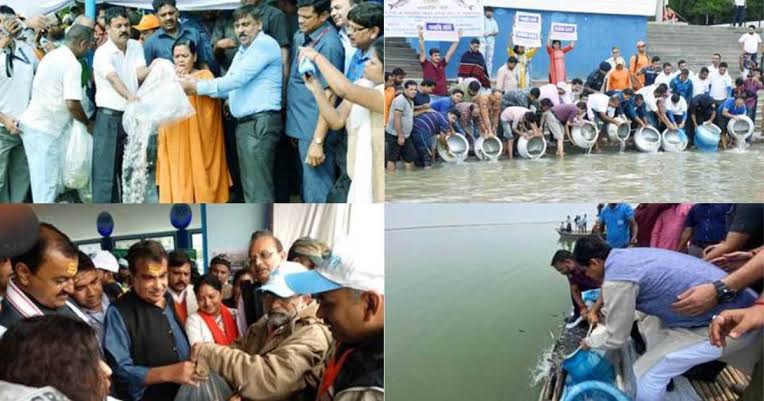
Several ranching events were conducted in the presence of senior policymakers, reinforcing public awareness and stakeholder participation in sustainable fisheries practices across the Ganga basin.
The Road Ahead
The past decade demonstrates that river restoration can deliver tangible outcomes when guided by science and sustained monitoring. Scientific river ranching under Namami Gange shows that native fish stocks can be replenished without compromising ecological balance.