
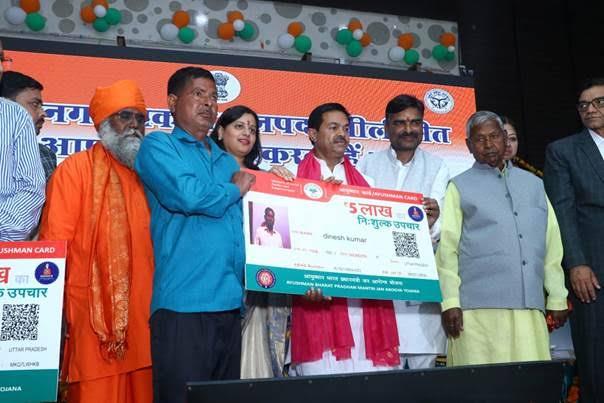
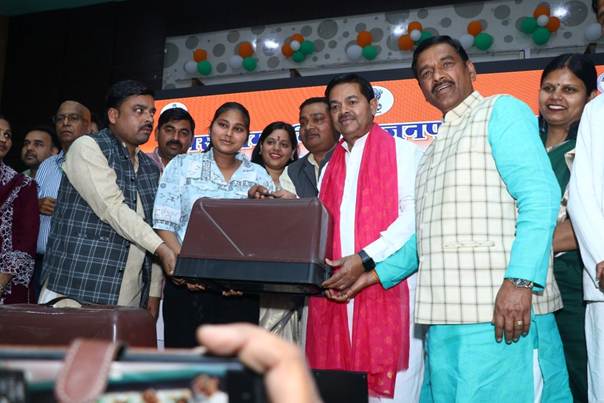
The programme was organised at Gandhi Prekshagrih, Gandhi Stadium in Pilibhit under the NAMASTE Scheme, which aims to ensure mechanized sanitation and eliminate hazardous manual cleaning. Shri B. L. Verma, Minister of State for Social Justice & Empowerment and Consumer Affairs, Food & Public Distribution, attended the event as chief guest.
Addressing beneficiaries, the Minister stressed the importance of dignity, safety and social security for sanitation workers. He reiterated the government’s commitment to uplifting historically marginalized communities through structured welfare measures.
Distribution of PPE Kits and Ayushman Cards
During the event, Personal Protective Equipment (PPE) kits were distributed to Sewer and Septic Tank Workers (SSWs) and waste pickers to enhance workplace safety. Ayushman Cards were also provided, ensuring access to health insurance coverage under the Ayushman Bharat scheme.
In Pilibhit alone, 92 SSWs and 452 waste pickers have been profiled under the NAMASTE framework. At the programme, PPE kits were distributed to 452 beneficiaries, while 30 individuals received Ayushman Cards.
Livelihood Support Through Skill Development
In addition to safety and health measures, the programme emphasized sustainable livelihood generation. Fifteen beneficiaries who successfully completed skill development training were provided sewing machines to support self-employment opportunities.
This component of the scheme reflects a broader approach that combines welfare with economic empowerment, enabling workers to diversify income sources and improve long-term stability.
National-Level Progress Under NAMASTE
Officials highlighted the nationwide achievements under the NAMASTE Scheme. So far, 89,248 sewer and septic tank workers have been verified across the country. Out of these, 87,037 workers have received PPE kits and 74,647 have been covered under the Ayushman health insurance scheme.
Additionally, 1,87,120 waste pickers have been profiled nationwide, bringing them into the formal support framework. These figures underline the scale and impact of the government’s mechanized sanitation initiative.
Commitment to ‘Priority to the Deprived’
Speakers at the event emphasized that the programme reflects the principle of “priority to the deprived.” By focusing on sanitation workers and waste pickers, the government aims to ensure that no vulnerable community is left behind.
The initiative aligns with the broader vision of Viksit Bharat 2047, which envisages inclusive growth and equal opportunities for every citizen. Ensuring safe working conditions and social protection for sanitation workers remains a key pillar of this vision.
Dignitaries in Attendance
The programme was attended by several public representatives and officials, including Shri Gulab Singh, Chairperson of the District Panchayat; Dr. Aastha Agrawal, Chairperson of the Municipal Council; MLAs Shri Swami Prakatanand, Shri Baburam Paswan and Shri Vivek Kumar Verma; MLC Dr. Sudhir Gupta; and Shri Sanjeev P. Singh, BJP District President.
Senior officials such as Smt. Yogita Swaroop, Senior Economic Advisor, Ministry of Social Justice & Empowerment, and Shri Prabhat Kumar Singh, Managing Director of the National Safai Karamcharis Finance and Development Corporation, were also present, along with district administration representatives.
Further information about the NAMASTE Scheme can be accessed through the Press Information Bureau website at https://pib.gov.in and the Ministry of Social Justice & Empowerment portal at https://socialjustice.gov.in.
The Pilibhit event stands as a reminder that sanitation workers form the backbone of urban and rural cleanliness systems. Through structured interventions in safety, health and skill development, the NAMASTE Scheme seeks to transform their working conditions and social standing across the country.