
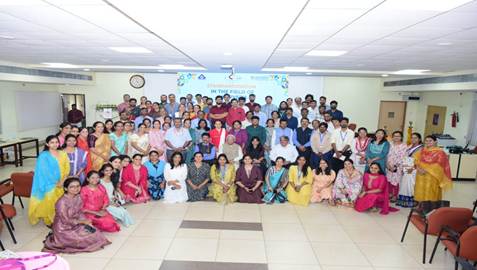
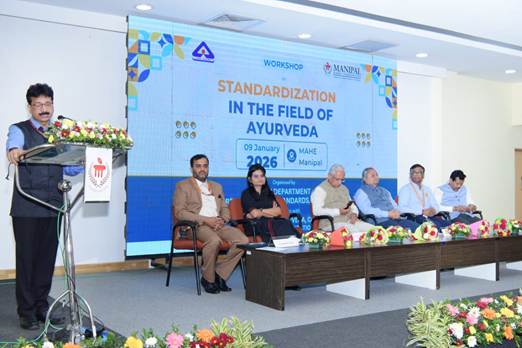

Organised under the aegis of the Ministry of Consumer Affairs, Food and Public Distribution, the workshop was conducted in collaboration with MAHE’s Division of Ayurveda, Centre for Integrative Medicine and Research. Nearly 180 delegates from across India participated, reflecting growing national momentum to position Ayurveda as a scientifically validated and globally trusted system of medicine.
The programme was designed exclusively for faculty members, researchers, entrepreneurs, and industry representatives working in the Ayurveda ecosystem. Discussions centred on aligning classical Ayurvedic knowledge with contemporary scientific methods without diluting its core principles.
Theme Rooted in Trust and Scientific Rigor
The workshop drew inspiration from BIS’s guiding motto, “Manakah Patha Pradarshaka”, underscoring the role of standards as guiding principles for consistency, safety, and public confidence. Speakers repeatedly emphasised that standardization is essential not only for domestic quality assurance but also for international acceptance of Ayurvedic products and practices.
Key Voices from Academia and BIS
Addressing the gathering, Jayant Deopujari, Chairperson of the Ayurveda Sectional Committee at BIS, highlighted that structured standardization is the bridge between ancient wisdom and modern regulatory expectations. He stressed that collective responsibility among policymakers, researchers, and industry players is crucial to establish Ayurveda as a globally reliable healthcare system.
Dr. Sharath K. Rao, Pro Vice-Chancellor (Health Sciences), MAHE, Manipal, echoed similar views during the inaugural session. He emphasised the urgent need for scientific benchmarks in traditional medicine systems and assured full institutional support from MAHE in advancing the Government of India’s standardization initiatives.
BIS Reaffirms Commitment to Quality
Shrishti Dixit, Head of the AYUSH Department at BIS, reaffirmed the organisation’s commitment to building a robust and inclusive standardization framework for Ayurveda. She noted that standards form the foundation of trust, which is indispensable for the wider adoption of Ayurveda both within India and internationally.
Expert Sessions and Industry Engagement
The workshop featured in-depth sessions by eminent experts, including Prof. Rabinarayan Acharya, Dr. Muralidhar R. Ballal, Dr. Manesh Thomas, and Devendra Reddy. The deliberations focused on interdisciplinary collaboration, regulatory compliance, and the role of standards in nurturing Ayurveda-based startups.
Participants actively engaged in open discussions, sharing practical insights and innovative ideas to address existing gaps in quality assurance and product validation.
Roadmap for the Future
Concluding the programme, Raghavendra Naik, Scientist-C at BIS, presented a comprehensive roadmap for Ayurveda standardization. He stressed the importance of interdisciplinary research, academia–industry collaboration, and targeted capacity-building initiatives to create a sustainable ecosystem involving policymakers, researchers, and manufacturers.
The workshop marked a critical milestone in India’s efforts to strengthen the scientific and regulatory foundations of Ayurveda, reinforcing its potential as a globally respected system of healthcare.