
A Platform for Sharing Best Practices
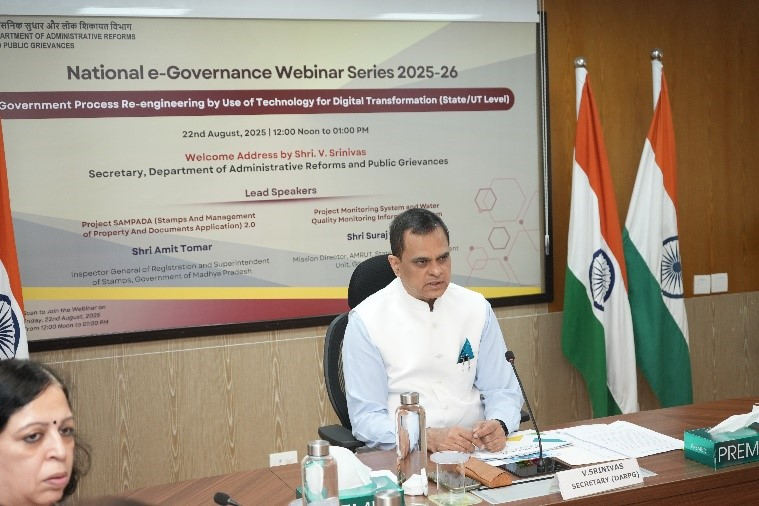
More than 400 senior officials, including District Collectors and representatives of Central and State Administrative Training Institutes, joined the session virtually. the series is designed to spread knowledge and encourage replication of innovative e-Governance practices recognized under the National Awards for e-Governance (NAeG).
Shri V. Srinivas, Secretary, DARPG, chaired the webinar and lauded the award-winning projects for adopting emerging technologies to simplify governance, improve transparency, and enhance citizen service delivery.

Shri Amit Tomar, Inspector General of Registration and Superintendent of Stamps, Government of Madhya Pradesh, presented the state’s flagship initiative SaMPADA (Stamps and Management of Property and Documents Application) 2.0. The platform has made property registration entirely paperless, queue-less, and boundary-less.
With features such as e-Stamping, template-based auto deed drafting, and document execution through e-Sign or Digital Signature Certificates (DSC), SaMPADA 2.0 enables citizens to complete registrations from anywhere, at any time. Select services are now available through faceless registration, eliminating the need for physical visits to the Sub-Registrar’s office.
The platform is integrated with GIS to pinpoint property locations and relies on open APIs for cross-departmental data sharing. More than 20 integrations have already been established, ensuring end-to-end automation of property registration and document management.
Kerala’s Digital Push for Water Safety and Urban Project Monitoring
The second presentation, delivered by Shri Suraj Shaji, Mission Director, AMRUT, showcased Kerala’s Project Monitoring System and Water Quality Monitoring Information System. This digital platform is transforming how urban projects are tracked and how water safety is ensured across the state.
The system automates workflows, provides real-time project tracking, and issues instant alerts in case of contamination. This enables timely corrective measures while ensuring compliance with water quality standards. It also offers secure data access to multiple stakeholders, enhancing accountability and decision-making.
A notable feature of Kerala’s model is the active participation of women-led self-help groups (SHGs) called AMRUT Mithras, who conduct on-ground water quality monitoring. Their involvement has strengthened community engagement and added a social empowerment dimension to the technological solution.
Driving Digital Transformation Across India
Both SaMPADA 2.0 and Kerala’s monitoring system reflect the transformative potential of technology in re-engineering governance processes. While Madhya Pradesh has redefined citizen convenience in property registration, Kerala has set a benchmark for participatory, tech-enabled water safety management.
The webinar series provides states and union territories with actionable insights, encouraging the adaptation of proven models to local contexts. Officials noted that such knowledge-sharing sessions help accelerate India’s journey toward inclusive and transparent digital governance under the Digital India mission.