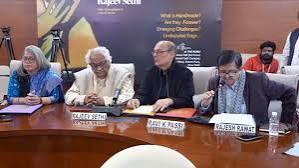
The celebrations of National Handicrafts Week 2025 concluded in New Delhi with the launch of the first-ever Kamladevi Chattopadhyay Craft Lecture Series, marking a significant moment for India’s craft sector. The inaugural lecture, themed “Handmade for Gen-Next,” was delivered by renowned designer and Padma Bhushan awardee Shri Rajeev Sethi at the International Craft Complex, The Kunj.
 Tribute to Kamaladevi Chattopadhyay
The lecture series is a tribute to Kamaladevi Chattopadhyay, widely regarded as the mother of India’s craft renaissance. Her pioneering efforts helped revive and institutionalise India’s handicraft and handloom traditions at a time when indigenous crafts were struggling to survive.
Kamaladevi’s lifelong work empowered artisans, strengthened local livelihoods and positioned Indian handicrafts on the global stage. The new lecture series seeks to carry forward her vision by creating a platform for critical dialogue on crafts, design and cultural sustainability.
Eminent Presence from Craft and Policy Circles
The inaugural lecture witnessed the presence of several senior officials and industry leaders. Among those attending were Smt. Amrit Raj, Development Commissioner (Handicrafts); Dr. M. Beena, Development Commissioner (Handloom); and Shri Ravi K. Passi, former Chairman of EPCH.
Shri Rajesh Rawat, Additional Executive Director of EPCH, was also present along with more than 100 participants. The audience included prominent designers, scholars, Shilp Gurus, National Award-winning artisans and architects, reflecting the diversity and depth of India’s craft ecosystem.
‘Handmade for Gen-Next’: Key Reflections
In his keynote address, Shri Rajeev Sethi raised fundamental questions about the future of handmade crafts in an era dominated by rapid technological change. He explored whether handmade traditions can endure amidst automation, mass production and cultural homogenisation.
Emphasising the irreplaceable value of the human hand, Shri Sethi highlighted intuition, skill and sensitivity as creative forces that no machine can fully replicate. He argued that handmade crafts remain deeply relevant, not only culturally but also economically and environmentally.
Crafts, Sustainability and Social Impact
Shri Sethi drew attention to the strong alignment between handmade crafts and sustainability. He noted that craft-based production relies on minimal mechanisation, local resources and decentralised livelihoods, making it inherently eco-friendly.
He also underlined the sector’s role in empowering women and marginalised communities across India. According to him, crafts provide dignity of labour and economic resilience, especially in rural and tribal regions facing migration pressures.
Artisans at the Heart of Inclusive Growth
Speaking on the occasion, Smt. Amrit Raj, Development Commissioner (Handicrafts), said the lecture served as a reminder that India’s millions of artisans remain central to the nation’s vision of inclusive and sustainable growth.
She stated that the Kamladevi Chattopadhyay Craft Lecture Series is a tribute to Kamaladevi ji’s insistence on integrating crafts with education, livelihoods and nation-building. The series, she added, would encourage deeper engagement with crafts among younger generations.
Role of Development Commissioner (Handicrafts)
The Office of the Development Commissioner (Handicrafts) functions as the nodal agency of the Government of India for artisan-based activities. It supports the development, marketing and export of handicrafts while promoting traditional skills and craft forms.
Through initiatives such as National Handicrafts Week and the newly launched lecture series, the ministry aims to strengthen policy discourse, celebrate craft excellence and ensure that India’s rich handmade heritage continues to thrive in contemporary markets.