
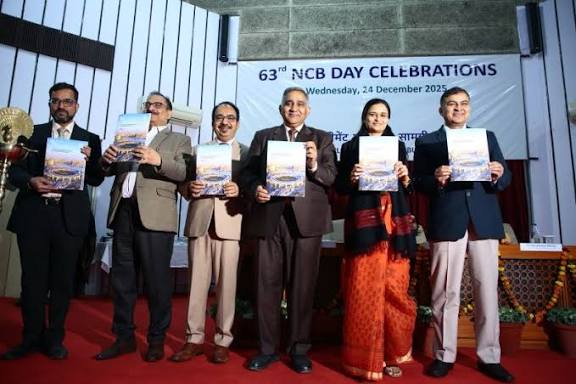

The report and laboratories were inaugurated by Economic Advisor, Department for Promotion of Industry and Internal Trade (DPIIT), Ms Urmila, IES, and Special Director General, Central Public Works Department (CPWD), Shri Mohd. Kamal Ahmad. The programme was held in the presence of NCB Director General, Dr L. P. Singh.
Senior officials, technical experts and stakeholders from the cement and construction ecosystem attended the Foundation Day celebrations, underscoring the significance of the occasion for the sector.
Strengthening Quality in Gypsum-Based Materials
The newly inaugurated Gypsum Board Testing Laboratory has been established to support quality assurance and standardisation requirements of the gypsum board industry. This development gains significance in light of the Gypsum-Based Building Materials (Quality Control) Order, 2024, notified by DPIIT.
The facility will enable manufacturers and regulators to ensure compliance with prescribed quality standards, contributing to safer and more durable construction practices across the country.
Advanced Research Through Micro-Characterisation
The Micro-Characterisation Laboratory is equipped with state-of-the-art analytical tools for detailed investigation of cementitious and construction materials. It will support advanced research into material properties, durability, and performance.
This laboratory is expected to play a critical role in developing next-generation construction materials that balance strength, cost efficiency and environmental sustainability.


Carbon Uptake by Concrete: Key Findings
The GCCA India–NCB report focuses on assessing carbon dioxide uptake by concrete through the natural process of carbonation in the Indian context. The study adopts the Tier-I methodology developed by the IVL Swedish Environment Research Institute.
The report highlights that while the cement industry contributes around 7 per cent of global anthropogenic CO₂ emissions, concrete also absorbs a measurable amount of carbon dioxide over its lifecycle, partially offsetting emissions.
Implications for Climate Reporting
The report outlines future actions to improve data robustness, refine estimation methodologies, and enhance scientific understanding of carbon uptake in concrete. These efforts aim to support the integration of carbon uptake into national sustainability and climate reporting frameworks.
NCB and GCCA India plan to submit the report to the Ministry of Environment, Forest and Climate Change for consideration of including carbon uptake by concrete as a carbon sink in India’s National Communications to the UNFCCC.
NCB’s Role in Sustainable Construction
Addressing the gathering, Ms Urmila appreciated NCB’s sustained contributions in research, technology development, quality assurance and capacity building, which have supported the evolving needs of the cement sector.
Shri Mohd. Kamal Ahmad also commended NCB’s research and development efforts in promoting sustainable construction practices, particularly in large public infrastructure projects.
About the National Council for Cement and Building Materials
NCB is an apex research and development organisation under the administrative control of DPIIT, Ministry of Commerce and Industry. It is dedicated to research, education, technology transfer and industrial services for cement, allied building materials and the construction sector.