
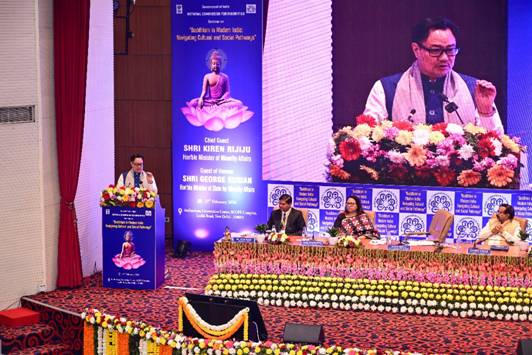
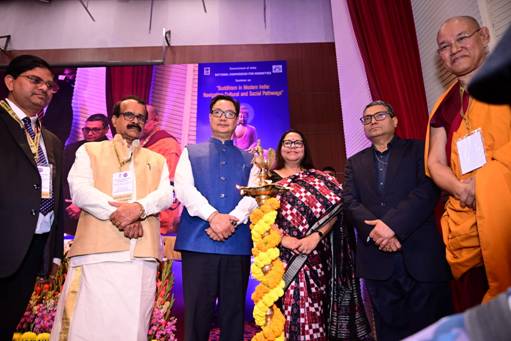

Union Minister of Minority Affairs Kiren Rijiju, who attended the event as chief guest, stressed the importance of preserving India’s rich Buddhist heritage while ensuring inclusive development for minority communities.
He underlined that Buddhism is not merely a religion but a civilisational philosophy that has shaped India’s cultural and spiritual identity for centuries.
Minister of State for Minority Affairs George Kurian echoed these sentiments and reaffirmed the government’s commitment to strengthening cultural identity and educational advancement among Buddhist communities across the country.


Diverse Participation from Across India
The seminar was held at the SCOP Complex in New Delhi and witnessed participation from senior government officials, academics, monks, and community representatives.
Among those present were Dr. Chandra Shekhar Kumar, Secretary, Ministry of Minority Affairs; Alka Upadhyaya, Secretary, NCM; and Dr. Atya Nand, Joint Secretary, NCM, along with officials from various ministries.
The event also saw the presence of Shartse Khensur Rinpoche Jangchup Choeden, Secretary General of the International Buddhist Confederation, highlighting the spiritual and global dimensions of the discussion.
Panel Discussion on Contemporary Challenges
A substantive panel discussion formed the core of the seminar. It was moderated by Niraj Kumar, Joint Secretary, Ministry of Development of North Eastern Region.
Distinguished speakers included Testen Tashi Bhutia, former Minister of Sikkim; Acharya Yeshi Phuntsok, a senior Mahayana Buddhist monk based in Delhi; Jigme Youdron Lhamo from Druk Drilburi Nunnery in Himachal Pradesh; Mahendra Bhante of Kushinagar; Professor Manish Sinha of Magadh University, Bodhgaya; and Professor Sanjeev Kumar H.M. of Delhi University.
The panellists deliberated on issues such as heritage conservation, youth engagement, educational opportunities, regional development, and the global relevance of Buddhist philosophy in promoting peace and social harmony.

Addressing Social and Cultural Pathways
Speakers emphasised that Buddhism continues to offer moral guidance and a framework for social cohesion in an increasingly complex world. They called for strengthening research initiatives, documentation of heritage sites, and academic engagement with Buddhist studies.
The discussion also touched upon the need for policy measures that support Buddhist educational institutions and cultural centres, particularly in states with significant Buddhist populations.
Participants agreed that modern communication tools and youth outreach programmes could play a crucial role in keeping Buddhist teachings relevant for future generations.
NCM’s Continued Commitment
In its concluding remarks, the National Commission for Minorities reaffirmed its commitment to facilitating dialogue, research and policy initiatives aimed at strengthening the cultural and social pathways of Buddhism in modern India.
The seminar marked another step in promoting inter-community understanding and ensuring that minority voices remain integral to India’s development narrative.