

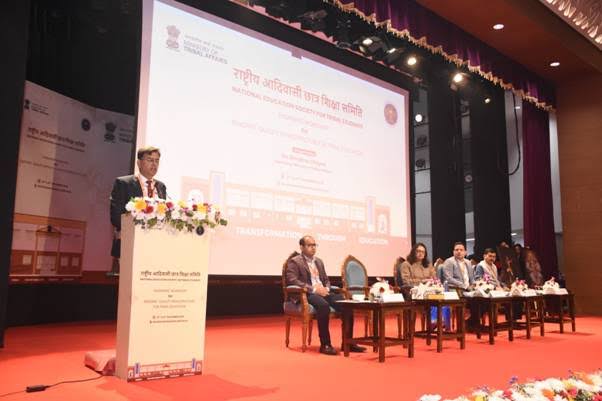

Ms. Ranjana Chopra, Secretary, Ministry of Tribal Affairs, inaugurated the workshop and released the EMRS Engineers’ Handbook for Building. She said the handbook aims to strengthen coordination between NESTS, project teams and site engineers, enabling consistent application of quality standards across EMRS projects.
“EMRS campuses are symbols of hope and opportunity for tribal children,” Ms. Chopra said. She stressed that timeliness and construction quality are non-negotiable; poorly completed schools mean children do not attend, which defeats the programme’s purpose.
Progress and priorities under EMRS
During the workshop, NESTS Commissioner Ajeet K. Srivastava highlighted programmatic milestones: 499 EMRSs are currently functional and 397 school buildings have been completed nationwide. The remaining schools are at various stages of construction or pre-construction, underscoring the need to accelerate delivery without compromising standards.
Delegates agreed that on-time completion with high construction quality is essential to deliver the educational outcomes envisaged under the EMRS scheme and the Government’s Tribal Transformation Through Education agenda.
Technical sessions focus on field realities
The capacity-building programme attracted engineers from central PSUs, the Central Public Works Department (CPWD), state governments and private construction agencies. Sessions covered project planning and monitoring, geotechnical investigations, material testing, earthwork and reinforcement practices adapted to tribal regions.
Speakers emphasised tailoring architectural layouts and construction techniques to local geography and cultural contexts. Delegates discussed region-specific challenges such as difficult terrain, monsoon impacts, and local material availability and shared adaptive solutions to ensure longevity and low maintenance.
Expert inputs and collaborative problem solving
Experts from IITs, NITs, the Central Building Research Institute (CBRI), and the Sports Authority of India (SAI) provided technical guidance on quality assurance, structural safety and project management. Practical demonstrations and interactive Q&A sessions enabled site engineers to address everyday field issues and clarify technical specifications from the new handbook.
Participants highlighted the value of common quality benchmarks, standardised testing protocols and transparent communication channels between project authorities and contractors to reduce rework and cost overruns.
Emphasis on safety, aesthetics and sustainability
Ms. Chopra called for schools that are not only safe and durable but also aesthetically appropriate and psychologically supportive for tribal children. The handbook, she said, integrates safety norms with considerations for sustainable materials, energy efficiency and climate-resilient design.
Speakers recommended integrating biophilic elements, improved sanitation, and site-sensitive landscaping to create learning environments that inspire pride and belonging among students and communities.
Next steps: monitoring, capacity and community engagement
The workshop concluded with commitments to strengthen monitoring mechanisms, expedite technical clearances and enhance field-level capacity. NESTS will support follow-up training and technical assistance to states and implementing agencies to ensure handbook recommendations are implemented on the ground.
Officials stressed the importance of community engagement consulting local stakeholders and incorporating indigenous knowledge where feasible to make EMRS campuses culturally relevant and better maintained over time.
The NESTS initiative aligns with broader tribal education goals set out by the Ministry of Tribal Affairs.