

Judicial leadership urges proactive measures
Justice Prakash Shrivastava, Chairperson of the NGT, led the conference with a strong message: industries must shoulder responsibility for ecological restoration. Justice Shrivastava invoked a recent judgement emphasising corporate accountability and urged a shift from passive regulation to proactive remediation by polluters and regulators alike.
In the valedictory session, Justice R. Mahadevan of the Supreme Court underscored that environmental protection and biodiversity conservation must be twin priorities for policymakers, courts and enforcement agencies going forward.
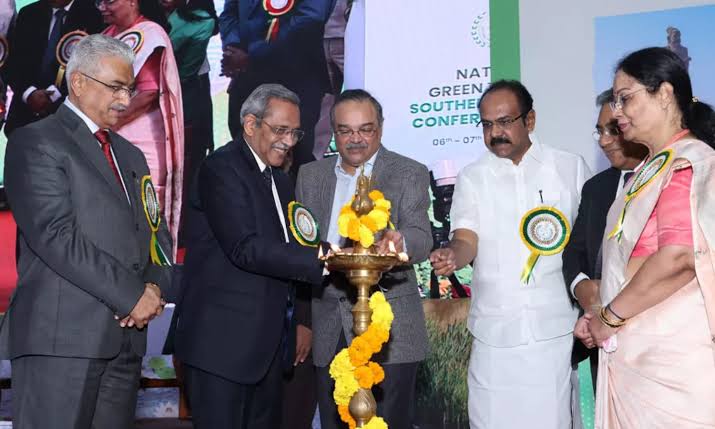

Sessions chaired by senior jurists highlighted the scale of coastal degradation. Justice Suraj Govindaraj, Judge of the Karnataka High Court, named plastic pollution and unchecked urban development as grave threats to marine life, citing disturbing evidence such as marine mammals found with multiple plastic bags.
Dr Murali Krishna Chimata of the Ministry of Environment, Forest & Climate Change (Regional Office, Vijayawada) warned that India’s 11,098.81 km coastline faces severe pressures: an estimated 11–12 million tonnes of plastic enters marine systems annually, with consequent habitat loss and the creation of ‘dead zones’. He stressed the economic stakes billions rely on oceans for food and livelihoods and urged national and local action to curb pollution and restore habitats.
Kerala, Tamil Nadu highlight local challenges
Panelists from southern states described localized impacts and enforcement gaps. Dr Kalaiarasan (Government of Kerala) pointed to widespread erosion and shoreline change—data showing 34% erosion and 26.9% accretion between 1992–2022—and the difficulty of enforcing regulations across dynamic sediment cells. He recommended sediment-cell–based planning and stronger municipal waste management to halt shoreline loss.
Dr T.D. Babu, trustee of Nizhal, highlighted the ecological importance of seagrasses, mangroves and mudflats as carbon sinks, fish nurseries and coastal buffers. He warned these systems are declining under pressure from reclamation and unsustainable development and urged integrated coastal zone management that restores rather than fragments ecosystems.
Climate projections and long-term risks
Experts at the conference reviewed climate projections showing a likely temperature rise of 1.1°C–2°C by 2030 and up to 3.3°C–4.8°C by 2080 if current trends persist. Speakers tied these projections to increased storm surge risks, accelerated erosion and threats to fisheries and coastal livelihoods, calling for adaptive planning and nature-based solutions.
Law, governance and community action
Legal and administrative leaders, including Additional Solicitor General A.R.L. Sundaresan and Tamil Nadu’s Additional Chief Secretary Smt. Supriya Sahu, advocated stronger enforcement, clear restoration responsibilities for polluters and expanded public participation. Sundaresan urged a dual focus: protect the environment today and preserve biodiversity for the future.
Suhasri Sahu highlighted Tamil Nadu’s efforts to convert policy into action, stressing partnerships with communities, coastal fisher groups and local bodies to implement sustainable practices at scale.
Recognition and public outreach
The conference closed with a prize distribution to students and winners of environmental competitions, reinforcing the organisers’ focus on youth engagement. Speakers called for education, local stewardship and judicial oversight to create accountability and long-term behavioural change.
Way forward
Delegates left with a clear agenda: scale up habitat restoration (mangrove and seagrass protection), adopt sediment-cell planning, tighten pollution controls, and embed nature-based coastal defences into state action plans. Across sessions, there was consensus that judicial guidance, administrative follow-through and community leadership must converge for meaningful progress.