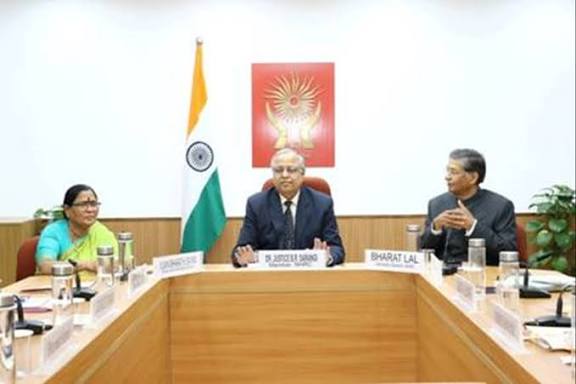
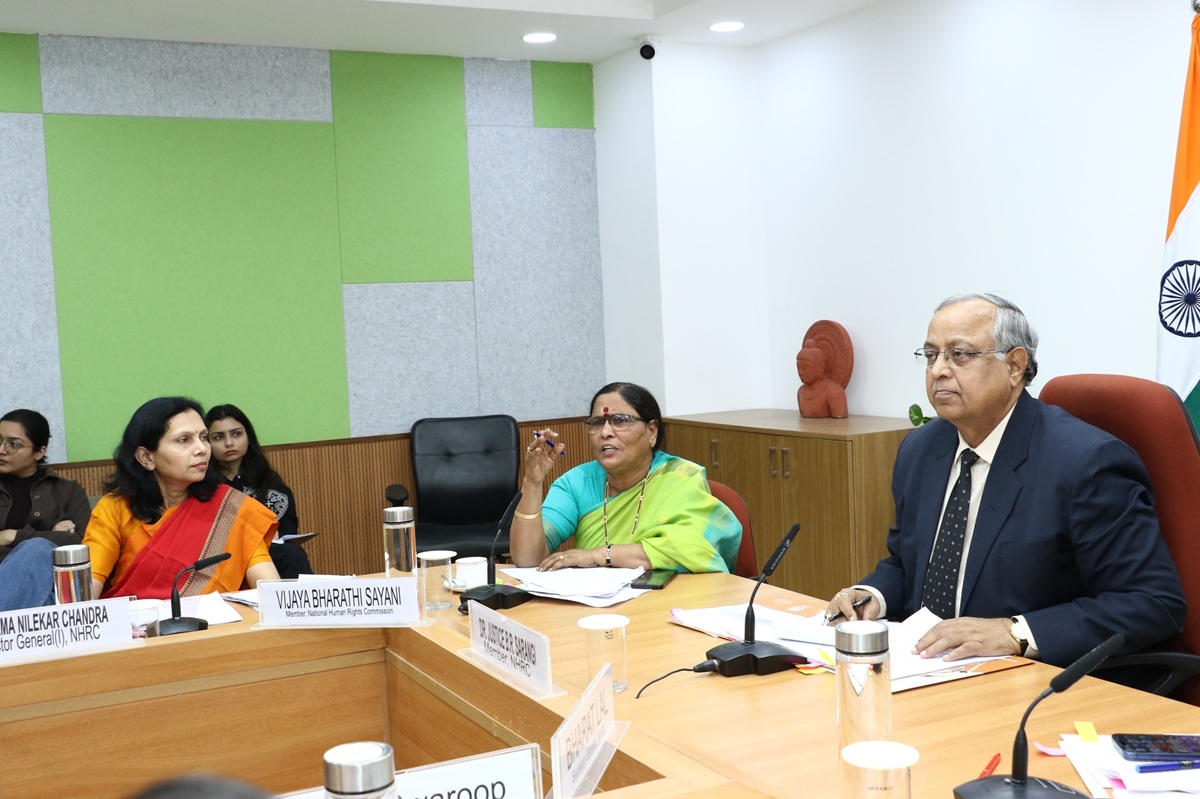
New Delhi, February 26: The National Human Rights Commission (NHRC), India has called for a comprehensive, rights-based national strategy to eliminate beggary, stressing dignity, rehabilitation and coordinated policy action over punitive measures. The call came during an Open House Discussion titled “Rethinking Beggary: Bridging Gaps between Policy, Practice and Dignity,” organised in hybrid mode in the national capital.
 Beggary a Structural and Social Challenge
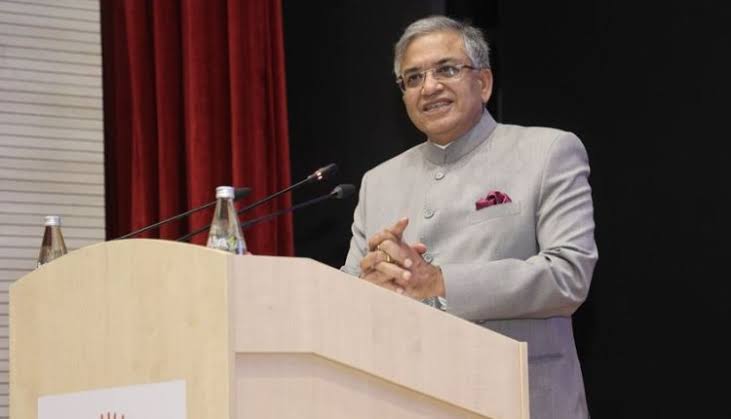
Chairing the session, NHRC Member Justice (Dr.) Bidyut Ranjan Sarangi described beggary as a persistent social concern that undermines constitutional guarantees of equality and dignity. He observed that the presence of begging in one of the world’s largest economies signals deeper structural gaps requiring sustained policy attention.
Justice Sarangi emphasised that Article 14 of the Constitution the Right to Equality before law must extend meaningfully to individuals engaged in begging. He underlined that every citizen deserves a secure and dignified life, and that legal provisions alone are insufficient without measurable improvements in rehabilitation and reintegration.
He also called for a review of the implementation of the NHRC’s 2024 advisory on protection and rehabilitation of vulnerable persons engaged in begging, as well as the government’s SMILE-B (Support for Marginalised Individuals for Livelihood and Enterprise) scheme. According to him, eliminating beggary requires a rehabilitation-oriented strategy rooted in constitutional values and social protection.
Need for Data-Driven National Strategy
NHRC Member Smt. Vijaya Bharathi Sayani stressed the urgency of creating a coordinated national framework with clear timelines and accountability mechanisms. She advocated the development of a national portal and comprehensive survey, noting that reliable data is crucial for effective policymaking.
Calling attention to organised rackets, she urged strict action against beggary mafias and trafficking networks. At the same time, she emphasised that long-term rehabilitation and social reintegration must take precedence over temporary relief measures.
Campaign Mode Implementation and Aadhaar Linkage
NHRC Secretary General Shri Bharat Lal highlighted that while India has a robust constitutional and legal framework, meaningful change requires collaboration between government agencies, NGOs and civil society. He suggested adopting a bottom-up approach that addresses sector-specific challenges while advancing broader social inclusion.
He proposed taking up the issue in campaign mode with time-bound targets, ensuring that no vulnerable individual is left behind. He emphasised proactive identification efforts, issuance of Aadhaar cards through outreach camps and linking identified individuals with welfare schemes. Authorities, he said, should reach out to the destitute rather than expecting them to navigate administrative processes.
Officials from the Unique Identification Authority of India (UIDAI) detailed initiatives to enrol destitute persons, particularly children and persons with disabilities, through special Standard Operating Procedures developed in consultation with relevant ministries.
SMILE Scheme and Supreme Court Compliance
Smt. Yogita Swaroop, Senior Economic Advisor at the Ministry of Social Justice and Empowerment, cited 2011 Census data and outlined government initiatives under the SMILE Scheme aimed at education, skill development and sustainable rehabilitation. She also reiterated compliance with Supreme Court directives concerning beggary-related matters.
Speakers from state governments, law enforcement agencies and academic institutions contributed to technical sessions covering the scope and challenges of beggary, data and documentation gaps, and long-term employment-based solutions.
Key Recommendations from Multi-Stakeholder Deliberations
The consultation generated several actionable recommendations. Participants advocated a shift from criminalisation to social protection-based interventions, along with periodic impact assessments of existing state legislations and central schemes.
Among major proposals were the creation of a National Strategy on Beggary with defined roles and measurable outcomes; establishment of a unified national portal integrating identification and service delivery; nationwide hotspot mapping and real-time disaggregated data collection; and accelerated Aadhaar enrolment drives in shelters.
Participants also called for secure digital convergence of welfare databases, formal partnerships with NGOs for last-mile delivery, and institutionalised training for police and municipal authorities to foster a dignity-centric approach.
Strict enforcement against organised beggary rackets and trafficking networks was emphasised as a parallel priority to protect vulnerable individuals from exploitation.
Towards a Begging-Free India
The overarching message of the discussion was clear: eliminating beggary cannot rely solely on punitive laws. It demands coordinated national action grounded in constitutional values, accurate data, institutional accountability and community participation.
With renewed emphasis on rehabilitation, digital inclusion and inter-ministerial convergence, the NHRC signalled a policy shift toward ensuring that vulnerable citizens are reintegrated into mainstream society with dignity and sustainable livelihoods.