

The National Human Rights Commission (NHRC) of India on Thursday convened an important meeting of its Special Rapporteurs and Special Monitors in New Delhi, reinforcing their critical role in safeguarding human rights across the country. Chaired by NHRC Chairperson Justice V. Ramasubramanian, the meeting focused on strengthening grassroots monitoring, accountability mechanisms, and ethical public service.
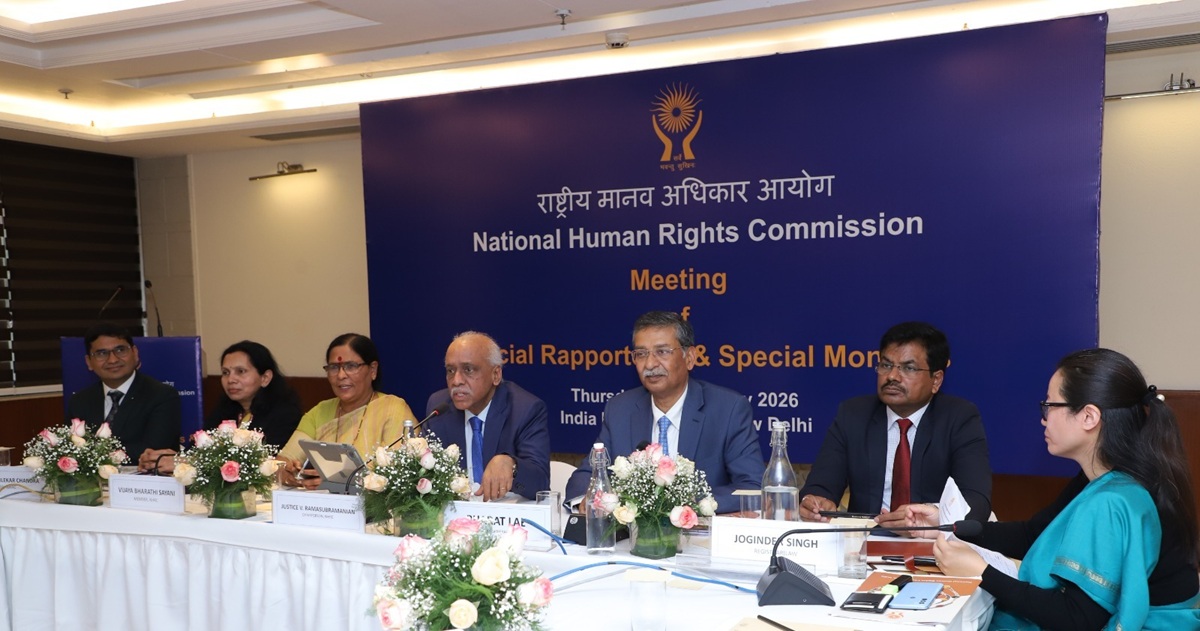

The NHRC Chairperson highlighted that the appointment of Special Rapporteurs and Special Monitors follows a rigorous and transparent selection process. Candidates are shortlisted based on professional credentials, field experience and alignment with specific thematic areas, ensuring domain expertise is effectively utilised.
He reaffirmed the Commission’s commitment to integrity and transparency, noting that carefully matching experts to relevant human rights themes significantly enhances the quality of monitoring, reporting and advisory functions. Justice Ramasubramanian urged the appointees to act as “foot soldiers” of the Commission, focusing on small yet meaningful interventions that can transform lives at the grassroots level.
Monitoring Must Lead to Accountability
NHRC Member Smt. Vijaya Bharathi Sayani underlined that the role of Special Rapporteurs and Special Monitors carries not just authority but a deep ethical responsibility. Drawing from field-level observations, she flagged persistent human rights concerns such as overcrowding in institutions, medical negligence, lack of gender and child sensitivity, delayed grievance redressal, and weak follow-up mechanisms.
She stressed that reports submitted to the Commission must move beyond mere documentation and evolve into tools of accountability. According to her, effective monitoring should result in corrective action, institutional reform and measurable improvement in the living conditions of vulnerable populations.
Six-Month Collaborative Action Plan
In his opening remarks, NHRC Secretary General Shri Bharat Lal elaborated on the concept and significance of Special Rapporteurs and Special Monitors in the protection and promotion of human rights. He urged newly appointed members to prepare a collaborative six-month action plan focusing on priority human rights issues and targeted field visits.
Describing the NHRC and its field functionaries as “conscience keepers,” he said their role involves identifying wrongdoing, systemic gaps or administrative inaction. Inputs from field visits, he noted, help the Commission issue advisories and policy recommendations to governments.
Data-Driven Interventions and Outreach
Shri Bharat Lal also highlighted the growing importance of data-driven interventions, suo motu cognisance, and thematic advisories in shaping policy reform. He cited NHRC advisories on beggary and reviews of the Transgender Persons Act and the Mental Healthcare Act as examples of evidence-based advocacy.
He encouraged Special Rapporteurs and Special Monitors to popularise the NHRC’s outreach initiatives, including multiple channels for filing complaints and the recently launched NHRC mobile application, to enhance public access to justice.
Diverse Participation Strengthens Human Rights Framework
NHRC Joint Secretary Shri Samir Kumar delivered a detailed presentation on the Commission’s human rights framework, organisational structure, complaint management system, core groups and operational guidelines for Special Rapporteurs and Special Monitors.
During the interactive session, each Special Rapporteur and Special Monitor shared insights from their professional experience, identifying areas of concern that require collective action. Participants emphasised collaboration across institutions to uphold human dignity for all.
Experienced Professionals Appointed
The meeting was attended by 30 Special Rapporteurs and Special Monitors drawn from diverse backgrounds, including former civil servants, law enforcement officials, academics, civil society representatives, persons with disabilities and individuals from diverse gender identities.
The NHRC has appointed 15 Special Rapporteurs with effect from December 23, 2025, and 18 Special Monitors from January 2, 2026, each for a three-year term. Their detailed profiles are available on the official NHRC website at https://nhrc.nic.in. The official release was issued by the Press Information Bureau (PIB) on January 23, 2026.