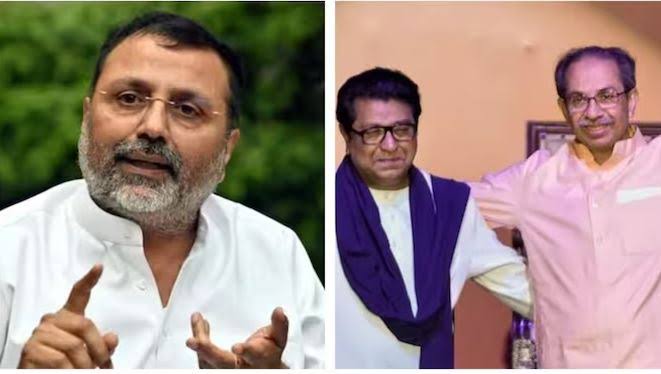
In a fiery political clash, BJP MP Nishikant Dubey slammed MNS chief Raj Thackeray for his controversial attack on non-Marathi speakers. This latest war of words adds fuel to the BMC elections 2025, making Mumbai’s politics even more charged.
 Raj Thackeray’s Remark Raises Tensions
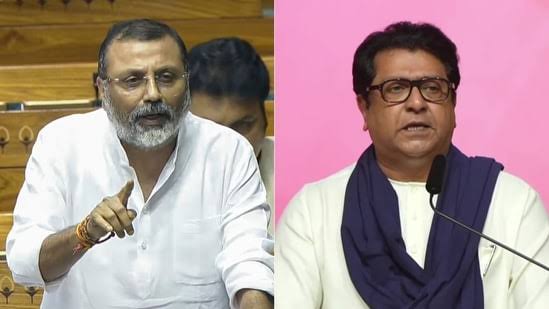
During a rally in Mumbai, Raj Thackeray insisted that anyone living in Maharashtra must speak Marathi. He urged party workers to “hit below the eardrums” those who insult the language. Furthermore, he advised them not to record such incidents.
The speech followed Raj and Uddhav Thackeray’s reunion on stage after two decades. Observers believe it was a calculated move ahead of the Brihanmumbai Municipal Corporation (BMC) elections.
Nishikant Dubey Responds with a Dare
Reacting strongly, Nishikant Dubey accused the Thackeray cousins of playing “cheap politics.” He criticized their rhetoric as divisive and opportunistic. “You are surviving on our money,” he said.
Challenging Thackeray further, Dubey added, “If you’re so brave, come out of Maharashtra. Come to Bihar, Uttar Pradesh, Tamil Nadu — we’ll hit you back hard.”
His statements seemed designed to rally support from North Indian migrants who have often faced hostility from the MNS.
Dubey Targets Thackeray’s Marathi Pride
The BJP MP questioned the authenticity of the Thackerays’ Marathi pride. He dared them to enforce their language agenda in places like Mahim, known for its Hindi and Urdu-speaking population. Dubey argued that their silence in such areas exposed their double standards.
He also reminded the public that industrial titans like Tata, Birla, and Reliance are national contributors, not confined to Maharashtra. “Tata’s first factory was in Bihar,” he emphasized, “so stop claiming Marathi superiority.”
Priyanka Chaturvedi Fires Back at Dubey
Shiv Sena (UBT) leader Priyanka Chaturvedi swiftly responded to Dubey’s comments. She asked, “Who made him the gatekeeper of Hindi or the spokesperson for Indian industry?”
In her statement, she also questioned whether Devendra Fadnavis, Maharashtra’s Deputy Chief Minister, endorsed such divisive language. Chaturvedi condemned Dubey for belittling the contribution of Maharashtra’s citizens.
Regional Identity vs National Unity
This controversy underscores the deep conflict between regional pride and national integration. The ongoing Marathi vs non-Marathi debate continues to divide voters in Mumbai. Raj Thackeray has consistently used this issue to position himself as the cultural guardian of Maharashtra.
On the other hand, the BJP’s aggressive response signals its commitment to defending the rights of North Indian migrants. These communities are integral to Mumbai’s economy and civic life.
Why BMC Elections 2025 Matter
All eyes are on the high-stakes BMC elections. Once a Shiv Sena stronghold, Mumbai’s civic body has become a battleground for survival and relevance. Internal rifts have weakened the Thackerays’ grip on power.
In contrast, the BJP sees an opportunity to take control. This war of words may be part of a larger strategy to polarize the vote and cement its influence in the city’s governance.
The Bigger Picture: National Implications
Such identity-driven clashes are not unique to Maharashtra. Across India, regionalism is often used to fuel political agendas. Emotional appeals around language and culture may bring short-term wins but create lasting fractures.
Looking ahead to the 2029 Lok Sabha elections, these localized flare-ups could shape national narratives. The challenge lies in balancing regional pride with the idea of a united India.
Conclusion: Time to Shift the Focus
The face-off between Dubey and Thackeray is a wake-up call. Voters must demand more from leaders than emotional manipulation. Instead of division, politics should focus on inclusivity, development, and respect for diversity.
It’s time to reject shallow vote-bank strategies and embrace policies that unite rather than divide.