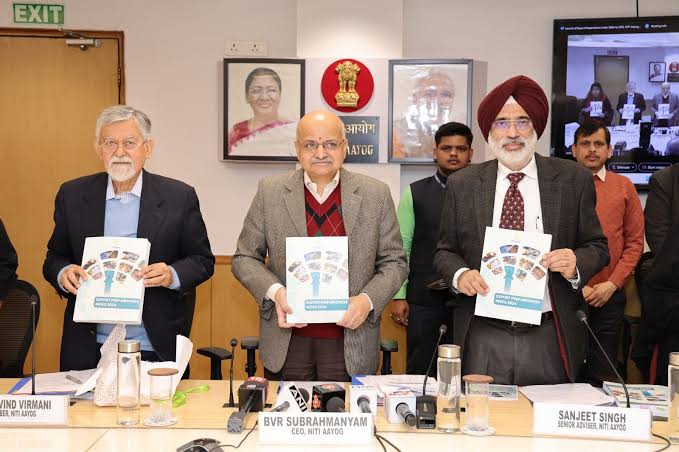
NITI Aayog on Tuesday released the Export Preparedness Index (EPI) 2024, offering a comprehensive assessment of export readiness across India’s States and Union Territories. The index highlights the critical role of subnational economies in driving India’s global trade ambitions and achieving the target of USD 1 trillion in merchandise exports by 2030.
 Focus on States and Districts
Speaking at the release, the CEO of NITI Aayog emphasised that India’s export growth increasingly depends on the preparedness of States and districts. Strengthening export infrastructure, improving cost competitiveness, building strong institutions and ensuring predictable policy environments were highlighted as key priorities.
Member NITI Aayog Dr. Arvind Virmani underlined the role of States and Union Territories in identifying local strengths, addressing structural gaps and leveraging emerging global trade opportunities. He reiterated the Prime Minister’s call for improving product quality to enhance international competitiveness.
Framework of EPI 2024
The Export Preparedness Index 2024 is structured around four major pillars, supported by 13 sub-pillars and 70 indicators, allowing for a granular and policy-relevant evaluation of export preparedness.
- Export Infrastructure
- Business Ecosystem
- Policy and Governance
- Export Performance
The 2024 edition enhances analytical depth by incorporating new dimensions such as macroeconomic stability, cost competitiveness, human capital, access to finance and the MSME ecosystem.
Classification of States and UTs
For meaningful comparison and peer learning, States and Union Territories have been grouped into Large States, Small States, North Eastern States and UTs. Within these categories, they are classified as Leaders, Challengers and Aspirers, based on their level of export preparedness.
Greater emphasis has been placed on districts as core units of export competitiveness, enabling place-based strategies linked to local industrial clusters and value chains.
Top Performers in EPI 2024
Leading Large States:
- Maharashtra
- Tamil Nadu
- Gujarat
- Uttar Pradesh
- Andhra Pradesh
Leading Small States, North Eastern States and UTs:
- Uttarakhand
- Jammu and Kashmir
- Nagaland
- Dadra and Nagar Haveli & Daman and Diu
- Goa
Data-Driven and Policy-Oriented
The index is based on official data from Central Ministries, State Governments and public institutions. Indicators are normalised and aggregated using robust statistical techniques, with balanced weightage across pillars to reflect their contribution to export preparedness.
NITI Aayog stated that the EPI 2024 is intended to serve as a diagnostic and action-oriented tool to support policy reforms, reduce regional disparities and strengthen India’s integration into global value chains amid rising global volatility.