
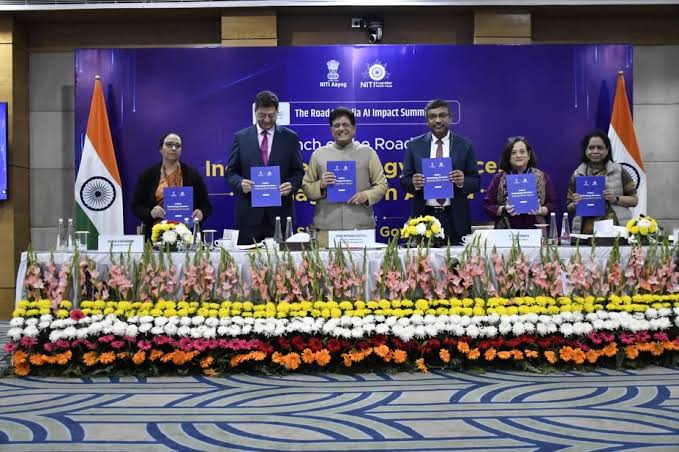
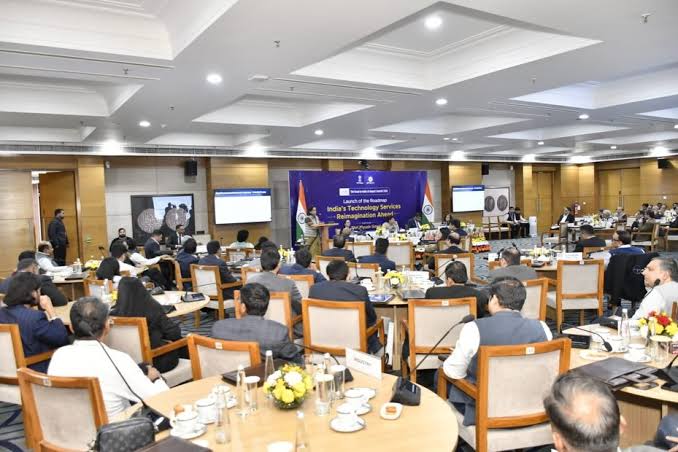

The roadmap was unveiled by Union Commerce and Industry Minister Piyush Goyal in the presence of senior government officials, industry leaders, and technology experts. It aligns closely with the government’s broader “Viksit Bharat 2047” vision, which seeks to transform India into a developed nation powered by innovation, technology, and sustainable economic growth.
the roadmap outlines how India’s globally recognized technology services industry can evolve beyond traditional outsourcing models to become a leader in AI-driven innovation and platform-based technology delivery.
Government officials emphasized that the roadmap represents a collaborative effort involving policymakers, industry leaders, and academic experts to strengthen India’s global competitiveness in the rapidly evolving digital economy.
Artificial Intelligence to Drive Structural Transformation
The report identifies artificial intelligence as the central force reshaping the global technology services industry. Traditionally, India’s technology sector has grown on labour-based outsourcing services. However, the AI era is expected to shift the focus toward intellectual property-led services, outcome-based solutions, and platform-driven delivery models.
This transformation presents India with an opportunity to move beyond being the world’s outsourcing hub to becoming a global leader in building AI-native systems and digital solutions.
The roadmap highlights that AI technologies will enable automation, efficiency improvements, and innovation across sectors such as healthcare, manufacturing, logistics, and financial services.
India’s large talent pool, strong IT services ecosystem, and expanding digital infrastructure position it well to capitalize on this shift.
Five Strategic Growth Levers Identified
The roadmap outlines five key pillars that will drive the expansion of India’s technology services sector. These include Agentic AI, development of software and products, strengthening digital infrastructure, innovation-led engineering, and creating India-focused solutions that can later scale globally.
Agentic AI refers to intelligent systems capable of autonomous decision-making and task execution. These systems are expected to redefine how businesses operate, enabling faster and more efficient service delivery.
Investment in software and product innovation is also considered critical. Moving from service delivery to product ownership will help Indian companies create higher-value intellectual property and strengthen global competitiveness.
Enhanced digital infrastructure, including cloud computing, data centers, and semiconductor capabilities, will play a vital role in enabling this transition.
Government and Industry Coordination Essential for Success
The roadmap emphasizes the need for coordinated action between government and industry. This includes accelerating enterprise adoption of AI technologies, increasing investments in research and development, and expanding workforce training and reskilling programs.
Government initiatives such as semiconductor development programs, regulatory reforms, and education-to-employment pipelines are expected to support the industry’s growth.
Officials noted that regulatory clarity and supportive policies would enable Indian technology companies to compete effectively in global markets.
The roadmap also calls for scaling workforce reskilling programs nationwide to ensure that India’s workforce is prepared for AI-driven jobs.
Government and Industry Leaders Emphasize Strategic Opportunity
Speaking at the launch, Commerce and Industry Minister Piyush Goyal said India is at a defining moment in its technology journey. He emphasized that the roadmap will help create an ecosystem that encourages innovation, supports industry growth, and strengthens India’s global leadership.
Officials from the Ministry of Electronics and Information Technology highlighted that India is pursuing a comprehensive AI strategy spanning infrastructure, chips, software models, and real-world applications.
NITI Aayog leadership described the rise of AI as a generational opportunity that can create new economic value, improve skill levels, and generate high-quality employment.
Industry experts also emphasized that India’s technology sector has repeatedly adapted to global changes, from early IT outsourcing to cloud computing and digital transformation.
Economic Impact and Employment Potential
The roadmap is expected to have a significant impact on India’s economy by creating millions of high-quality jobs and strengthening export capabilities.
Technology services are a major contributor to India’s GDP and export earnings. Expanding this sector will help increase foreign exchange inflows and boost economic growth.
The roadmap also supports India’s goal of becoming a global innovation hub, attracting investments, and strengthening technological leadership.
By focusing on innovation, intellectual property creation, and AI-driven solutions, India aims to move up the global value chain.
Future Outlook: India’s Path to Global Tech Leadership
The roadmap provides a clear strategy for transforming India’s technology services sector over the next decade. It outlines specific actions needed to enhance innovation, strengthen infrastructure, and prepare the workforce for future technological challenges.
The NITI Aayog Frontier Tech Hub will continue working with government, industry, and academic partners to implement the roadmap’s recommendations.
With strong policy support, industry collaboration, and continued investment in innovation, India is well-positioned to emerge as a global leader in AI-driven technology services.
The roadmap marks a critical step in India’s journey toward becoming a developed, technology-driven economy by 2047.