
A Bold Vision for Viksit Bharat
The framework, developed by the Capacity Building Commission (CBC), is central to the government’s Mission Karmayogi initiative. Dr. Singh emphasized that the new standards reflect Prime Minister Modi’s call for “out-of-the-box thinking” and innovation in governance.
“NSCSTI 2.0 is not just a compliance tool—it’s a tool for transformation,” he said. It encourages institutes to self-assess, compete, and continuously improve. Just like the Aspirational Districts Programme, the framework pushes underperforming CSTIs to aim higher.


The new framework reduces evaluation metrics from 59 to 43. This ensures clarity, simplicity, and sharper focus. More than 160 Civil Service Training Institutes (CSTIs), assessors, and experts participated in the consultative process.
It is also digitally aligned—embracing AI-driven tools, hybrid learning models, and e-learning platforms. Importantly, it integrates progressive ideas like the Indian Knowledge Systems (IKS), Karmayogi Competency Model (KCM), and Amrit Gyaan Kosh (AGK).
Inclusive and Adaptable for All Levels
One key strength of NSCSTI 2.0 is its flexibility. It applies to training institutes at the central, state, and local government levels. Whether it’s an Administrative Training Institute (ATI) or a small Urban Local Body training center, the framework fits.
This inclusivity promotes cooperative and competitive federalism. Institutes can now benchmark themselves, adopt best practices, and learn from top-performing peers across India.
Bridging Public and Private Practices
Dr. Singh noted, “We have removed unreasonable barriers between public and private sectors. Now, the best practices from both worlds can be integrated into our training ecosystem.”
This approach strengthens the administrative preparedness of scientific institutions, not just their technical expertise. Customized training modules will ensure better policy execution and public service delivery.
Global Recognition for Mission Karmayogi
Countries like Bangladesh, South Africa, and Maldives have shown interest in India’s civil services reform model. The international community views Mission Karmayogi as a template for future governance innovation.
“It’s a proud moment. India is now leading by example in transforming governance structures,” said the Minister.
Real Impact, Real Numbers
In just two years, 195 CSTIs have been accredited under the NSCSTI framework. With NSCSTI 2.0, the government has reactivated the accreditation portal to ensure a transparent and streamlined process.
The new framework acts as a motivational tool. Accreditation is no longer a burden—it’s a driver of quality. It builds public confidence and improves the performance of training institutes.
Leadership and Participation
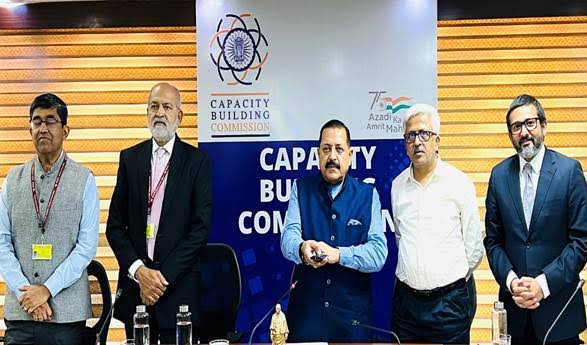
The launch event witnessed participation from key leadership figures: Adil Zainulbhai (Chairperson, CBC), Dr. R. Balasubramaniam (Member, HR), Dr. Alka Mittal (Member, Admn), V. Lalithalakshmi (CEO, Karmayogi Bharat), and Syama Prasad Roy (Joint Secretary, CBC).
Faculty from multiple training institutions attended, reflecting a strong sense of ownership and alignment with the mission of “Viksit Bharat”.
Toward a Citizen-Centric Future
Dr. Singh concluded by praising the CBC’s effort in creating a dynamic and adaptable training model. He expressed confidence that NSCSTI 2.0 will help India move closer to a citizen-centric governance ecosystem.
With clear standards, digital tools, and a collaborative spirit, India’s bureaucracy is being reshaped—one training institute at a time.