
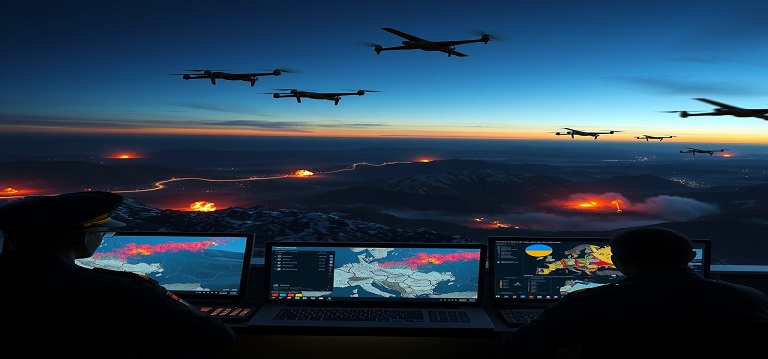
On June 2, 2025, Ukraine launched one of the most audacious and strategic strikes in its ongoing war with Russia. By targeting multiple deep-inland Russian airbases across three time zones, the scale and precision of this drone attack shocked the global defense community. Some Russian commentators have likened it to “Pearl Harbor”, the surprise World War II assault that pulled the United States into the global conflict. This attack is not just a turning point in the war but holds critical lessons for India and other countries preparing for future wars.
1. The Attack: Ukraine Strikes Deep Into Russia
Ukraine launched over 100 drones in a coordinated strike against Russian airbases in Olenya, Murmansk, Irkutsk, and other strategic locations. These areas are over 6,000 km from the Ukrainian border and lie across three different time zones — highlighting the logistical sophistication behind the operation.
Key losses to Russia:
-
Destruction of at least 40 strategic bombers, including TU-95 and TU-22 aircraft.
-
Damage to the A-50 surveillance aircraft, a key radar platform.
-
Possible disruption to Russia’s strategic nuclear delivery capability.
Ukraine’s President Volodymyr Zelensky confirmed the operation, emphasizing no NATO involvement and that it was conducted using indigenous technology and tactics.
2. Why “Pearl Harbor” Comparison?
The term “Pearl Harbor” evokes memories of Japan’s 1941 surprise attack on the U.S. naval base in Hawaii, which forced America into World War II. Similarly, Ukraine’s timing was critical — the strike happened just before the second round of peace talks in Istanbul.
This suggests the intent was not just military damage but strategic provocation, forcing Russia into escalation and possibly drawing global players further into the conflict.
3. Strategy & Technology: Lessons in Asymmetrical Warfare
Military analysts noted that the operation followed Admiral William McRaven’s doctrine:
“Simple plans, careful secrecy, and swift execution.”
Ukraine used:
-
Commercial high-resolution satellite imagery to identify exposed aircraft.
-
Container-launched drones to avoid detection and maximize mobility.
-
Independent execution without Western military hardware.
This shows that even without massive budgets or NATO backing, modern technology and planning can yield enormous impact.
Source: Institute for the Study of War (ISW), BBC, Kyiv Independent
4. Is Russia Preparing for Nuclear Escalation?
In response, Russia launched 400+ drones in retaliation the next day and hinted at using hypersonic missiles. These weapons, such as the Kinzhal, are capable of bypassing conventional air defenses.
The possibility of nuclear escalation has now become more real, as the strategic bombers targeted were part of Russia’s nuclear triad.
5. Drone Warfare is the Future
The Ukraine-Russia war confirms a new era of warfare, where First Person View (FPV) drones, cheap yet precise, dominate the battlefield. Similar tactics were seen earlier in:
-
Saudi Aramco attack (2019) by Houthi rebels.
-
Armenia-Azerbaijan conflict, where Turkish drones shifted the war balance.
These cannot be jammed easily and provide low-cost but high-impact strikes on strategic assets.
6. What India Must Learn
India must extract urgent lessons from this:
-
Airbase Protection: After the 2021 Jammu airbase drone attack, India must ensure all aircraft are stored in blast-proof shelters, not open tarmacs.
-
Counter-UAS Systems: DRDO and private players are developing anti-drone tech, but mass deployment is now vital at every airbase and border outpost.
-
Satellite Vulnerability: High-resolution satellite imagery from companies like Maxar or Planet Labs is available commercially. Enemy states can use this to track our troop movements and air assets.
-
Special Forces Modernization: Ukraine’s operation shows the power of elite, agile units. India has precedents like Operation Jackpot (1971), but adopting modern rapid-response doctrine is essential.
7. What Lies Ahead Globally
Ukraine’s “Pearl Harbor-style” strike is not just a military action — it has shattered assumptions about distance, deterrence, and dominance. Putin’s response will determine whether this escalates into a broader European or even global conflict.
The Kremlin has declared an emergency, convened a national security meeting, and begun relocating its bomber fleets. Russia has also accused NATO of providing satellite intelligence and possibly hacking its defense systems, which, if true, risks direct conflict between Russia and Western powers.
Conclusion: Strategy Over Strength
The new age of war is not just about guns and tanks, but data, drones, and decisiveness. India, like all modern militaries, must pivot from traditional defense thinking to smart, tech-enabled strategies. The battlefield is no longer just on land — it’s in the skies, in cyberspace, and inside the algorithm.
References / Bibliography:
-
ISW Daily Reports (June 2025)
-
BBC World News, Russia-Ukraine War Updates
-
Kyiv Independent, Zelensky Statements
-
Maxar Technologies (Commercial Satellite Use Cases)
-
Ministry of Defence, Government of India – UAS Procurement and DRDO updates
-
“Operation Jackpot 1971”, India’s Intelligence Archives
-
RAND Corporation – Asymmetric Warfare Studies