In the aftermath of the Bharat-Pakistan conflict of May 2025—codenamed Operation Sindoor—a growing body of international defense analysts has presented compelling evidence of heavy losses sustained by the Pakistan Air Force (PAF). Based on open-source intelligence, satellite imagery, and field reports, these analyses highlight India’s superior strategy, precision weapons, and technological edge.
Global Perspective on Pakistan’s Losses
Foreign neutral analysts have offered insights into the scale and nature of damage inflicted during the conflict. Here’s a breakdown of major expert assessments:
1. Tom Cooper (Air Combat Information Group – ACIG)
Tom Cooper, a world-renowned air warfare historian, released a detailed report confirming substantial PAF losses between May 7–10, 2025. His findings, supported by satellite images and photographs, reveal:
-
Destruction of multiple F-16s, JF-17s, and even a critical AWACS aircraft.
-
An estimated 20% loss of PAF infrastructure.
-
Key Pakistani airbases—Noor Khan, Rafiqui, and Bholari—were identified as primary targets.
-
Cooper also criticized Pakistan’s lack of transparency and information control following the attacks.
(Source: Indian Defence Research Wing, May 19, 2025)
2. Damien Symon (Geospatial Intelligence Analyst)
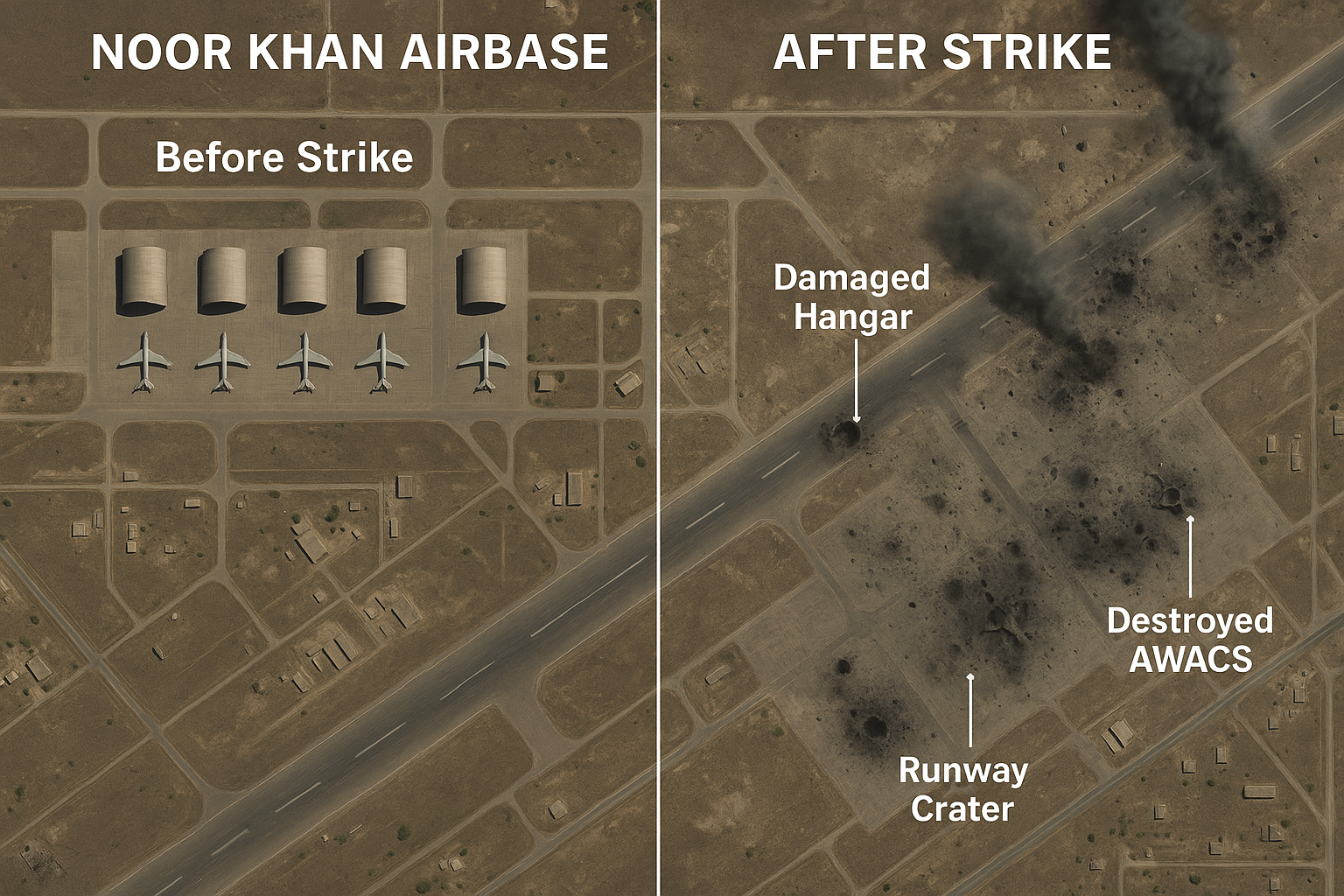
Using high-resolution satellite imagery from Maxar and Satellogic, Symon shared analysis via social media platform X, stating that India’s precision strike on Noor Khan Airbase had a devastating effect:
-
The entire complex was reportedly flattened, far exceeding initial assessments.
-
While the number of destroyed aircraft remains undisclosed, significant damage to hangars and support structures was confirmed.
-
The area affected was substantially larger than two heavy transport trucks, indicating widespread structural collapse.
(Source: India TV, May 25, 2025)
3. The New York Times Analysis
The New York Times, quoting unnamed defense experts and reviewing satellite data, corroborated widespread destruction:
-
Multiple F-16s and JF-17s were either damaged or destroyed.
-
Strategic infrastructure at Noor Khan Airbase, close to Pakistan’s nuclear command center, was severely damaged.
-
The report highlighted India’s ability to strike deep into Pakistani territory, showcasing the pinpoint accuracy of BrahMos missiles and questioning the effectiveness of Pakistan’s Chinese-made HQ-9 air defense systems.
(Sources: Navbharat Times, May 11; Moneycontrol, May 14, 2025)
4. European Think Tanks: ICCT and RUSI
A joint report by the International Centre for Counter-Terrorism (ICCT) and the Royal United Services Institute (RUSI) emphasized both tactical and technological superiority of the Indian Air Force:
-
Confirmed losses: 8–10 fighter aircraft, including F-16s, JF-17s, one AWACS, and possibly one C-130 transport aircraft.
-
Praised India’s use of BrahMos and SCALP missiles, and decoy aircraft that misled Pakistani radar systems.
-
Identified Pakistan’s limited geographic depth and technological constraints as key vulnerabilities.
(Source: AajTak, May 27, 2025)
5. Satellite Intelligence Firms (Maxar, Planet Labs)
Independent satellite imaging firms Maxar Technologies and Planet Labs confirmed major damage to infrastructure at Noor Khan, Rafiqui, and Bholari airbases. Their visuals showed:
-
Destroyed aircraft hangars and damaged runways.
-
However, these reports did not specify the exact number of aircraft destroyed.
6. IISS (International Institute for Strategic Studies)
The London-based defense think tank stated that Pakistan had recently received 20 J-10 fighter jets from China, but these did not influence Operation Sindoor:
-
Indian strikes neutralized critical infrastructure before these jets could be operational.
Conclusion: A Strategic Shift Recognized Globally
Operation Sindoor has drawn sharp attention in global military circles not just for its tactical execution but also for what it reveals: India’s growing military and technological capability. Analysts have pointed to India’s superior intelligence, precise strikes, and homegrown weapon systems as the defining factors of the operation.
While official statements from Islamabad remain guarded, neutral foreign observers increasingly agree—the Pakistan Air Force suffered a significant strategic setback. According to many, this shift in air superiority is one reason behind growing unease in Western diplomatic circles.