
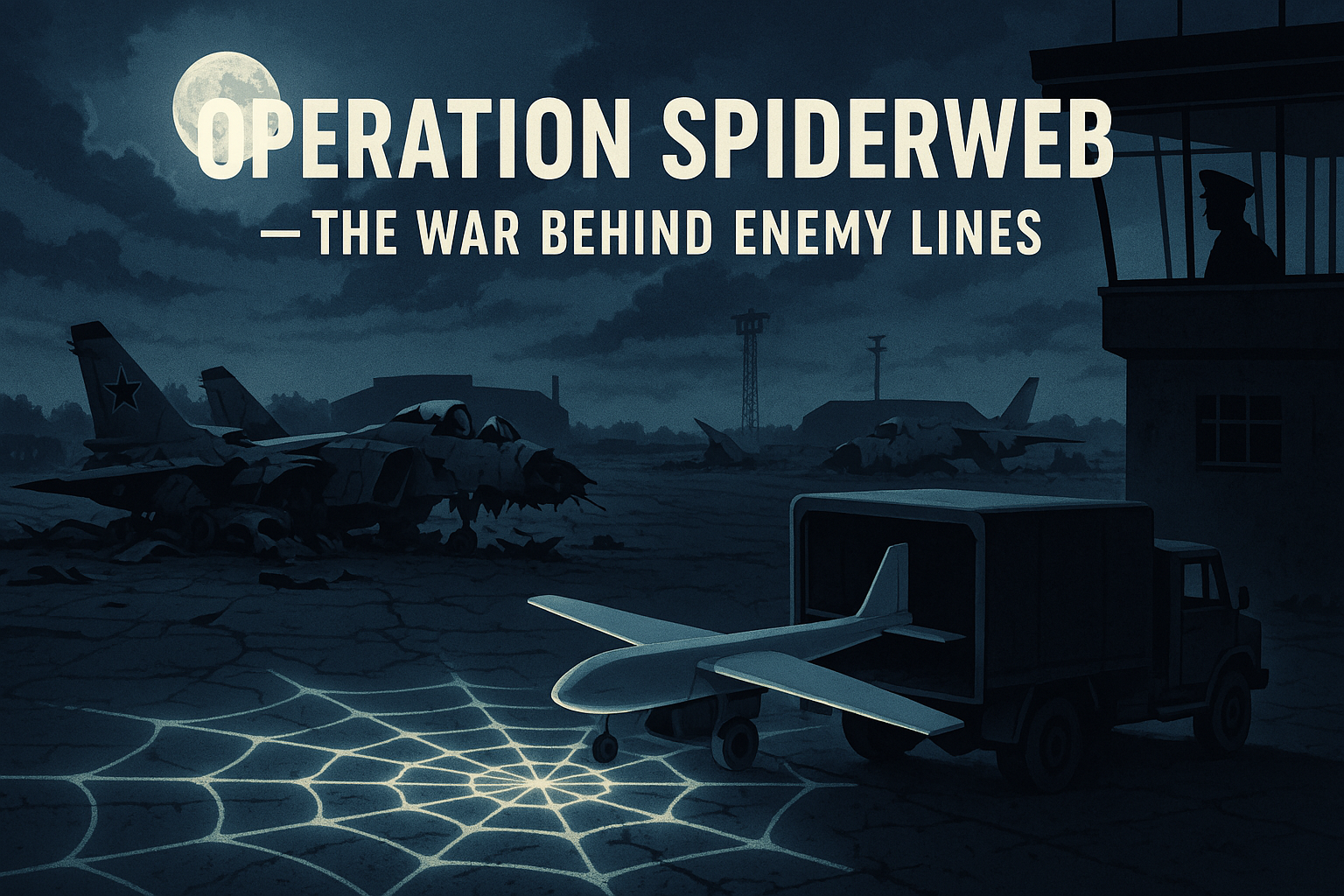
In modern warfare, the battlefield is no longer limited to land, air, or sea. It now includes something far more elusive — the human mind. And Ukraine’s recent “Operation Spiderweb” against Russia is a textbook example of this evolution.
More than 40 Russian aircraft destroyed, across four separate airbases spread thousands of kilometers apart. This was not a one-off drone attack. It was a coordinated strike deep inside Russian territory, a psychological trap crafted to sow panic and chaos — and it has succeeded beyond imagination.
🧠 Modern Warfare Is Psychological First, Physical Later
When Ukraine revealed full details about Operation Spiderweb, many asked: Why admit to such a risky and bold move so openly? The answer is simple:
Because modern warfare is not just about bullets and bombs — it’s about controlling the narrative.
The Operation Spiderweb attack was far too massive to hide. Surveillance satellites, leaked videos, eyewitnesses, and local chatter would have revealed the extent anyway. Ukraine decided to take charge of the story.
Rather than deny or stay silent, Ukraine revealed its hand — but did so in a way that magnified its psychological impact on Russia and the global audience.
🚛 The Attack Plan: Precision, Patience, and Paranoia
Operation Spiderweb was no ordinary drone strike. It involved:
-
Smuggling drones over 5,000 km inside Russia
-
Hiding them in decoy commercial trucks
-
Launching the attack from within Russia’s own logistical network
This wasn’t just a military operation, it was a psychological ambush. Every detail was chosen not only to cause destruction but to create long-lasting uncertainty.
“Ukraine didn’t just destroy jets. It destroyed peace of mind.”
Now, every Russian cargo truck is a potential threat. Every driver could be a saboteur. Every supply chain is under suspicion.
The result?
-
Fear
-
Paranoia
-
Escalating operational costs
-
Logistical delays and bottlenecks
🔍 Russia’s Nightmare: Paralyzed From Within
Due to the sheer scale and unpredictability of the attack, Russia is being forced to reorient its internal security protocols:
-
Inspection of all cargo vehicles
-
Wider surveillance of civilian road networks
-
Reallocation of military resources to internal logistics
-
Disruption of base operations and aircraft redeployment
And perhaps worst of all — Russia now fears its own population.
This is the true power of asymmetric warfare: You don’t need to outgun your opponent. You only need to make them distrust their own infrastructure and people.
✈️ Why This Operation Spiderweb Attack Was So Devastating
According to Ukrainian sources, the strike destroyed:
-
Dozens of TU-95 and TU-22 strategic bombers
-
A-50 radar surveillance aircraft
-
Multiple hangars, fuel depots, and air defense systems
The damage, if confirmed, would represent the largest single-day airpower loss for Russia since World War II.
Even more concerning for Moscow: These airbases housed elements of Russia’s strategic nuclear deterrent.
🧠 The Psychological Tactics at Play
Ukraine’s decision to disclose every step of the operation was part of the strategy. Here’s how:
-
Owning the Narrative
-
By publishing details, Ukraine turned the attack into a symbol of strength and resolve, not just for its citizens but also for Western allies.
-
-
Weaponizing Doubt
-
Russians are now doubting the reliability of their own roads, supply chains, and drivers.
-
-
Inviting Imitation
-
Other small nations are now observing how drones and satellite coordination can cripple even nuclear-armed superpowers.
-
-
Controlling the Global Perception
-
Ukraine’s version of the story went viral before Russia could respond. The world is now talking about Russian vulnerability, not Ukrainian aggression.
-
🇮🇳 What India Must Learn From Operation Spiderweb
As far removed as this conflict may seem, India has a lot to learn — urgently.
1. Airbase Vulnerability Must Be Addressed
India’s military airbases, including those near conflict-prone zones like Jammu, Pathankot, and Tezpur, have in the past remained vulnerable.
In 2021, drones dropped IEDs at Jammu Airbase in a suspected cross-border attack. While damage was limited, it exposed critical gaps.
India must move toward:
-
Blast-proof shelters for aircraft
-
Better radar coverage against low-flying drones
-
Rapid-response anti-drone systems
2. Counter-UAS (Unmanned Aerial System) Infrastructure Is Urgent
Organizations like DRDO, BEL, and private Indian startups are developing anti-drone systems, but deployment is not yet scaled.
India needs to fast-track:
-
360-degree drone detection grids
-
AI-based threat recognition systems
-
Dedicated anti-drone battalions for strategic assets
3. Cyber & Satellite Awareness
Ukraine used high-resolution commercial satellites to identify parked aircraft. These tools are available to adversaries too.
India must:
-
Mask its installations from satellite detection
-
Implement cyber-decoy operations to mislead foreign intelligence
-
Invest in space-based threat mapping tools
4. Asymmetric Warfare Planning
Ukraine’s operation proves you don’t need massive firepower — just strategy and stealth.
India must:
-
Build offensive and defensive drone strike units
-
Train special forces in covert sabotage missions
-
Ensure redundancy in logistics and communication chains
India’s 1971 “Operation Jackpot” is a glorious precedent. But modern warfare requires modern strategy.
🕹 The Future of War: Drones, Satellites, and Software
Operation Spiderweb signals a profound change in global military doctrine.
Gone are the days when wars were fought over borders. Today’s wars are fought in:
-
Airbase hangars
-
Supply routes
-
Media headlines
-
And most importantly, in the minds of citizens and soldiers alike
Ukraine may have only launched drones. But it delivered a masterclass in perception warfare, proving that when used strategically, technology can shake empires.
🧨 A Dangerous Precedent or a Necessary Warning?
Russia has called the attack a “terrorist act”, accusing Ukraine of violating trade protocols and committing a war crime.
“This is nothing short of a cowardly betrayal. Not warfare — but terrorism,” claimed a Russian diplomat in Moscow.
But for Ukraine, this was self-defense — and a message: If you invade us, we’ll haunt you on your own turf.
The global community now watches closely. Will this psychological ambush tactic become the new normal in warfare?
🧠 Conclusion: India Cannot Afford to Wait
India cannot assume that geography, diplomacy, or sheer military size will keep it safe.
-
Our bases are visible
-
Our infrastructure is exposed
-
Our enemies are watching — and learning
The future of warfare isn’t 10 years away — it’s here.
And Operation Spiderweb just proved how close it is.